
The biggest hurdle to overcome for most businesses looking to install electric vehicle (EV) charging infrastructure on their premises is the cost, especially if they want to install direct current fast chargers (DCFCs) as many do.
While Level 2 (L2) chargers will draw in some EV drivers, they are the more common type of charger and the one that most businesses and homes will have installed if they have EV charging. DCFCs are rarer and they are more likely to draw in EV drivers because they offer something different than what those drivers would have at home or at their workplace if their workplace offers EV charging. While L2 chargers take between four to eight hours to charge an EV battery, DCFCs provide the ability for fast charging and generally fill an EV battery in under an hour.
Although it is not recommended to use DCFCs for all charging needs because the heat generated by the charger increases wear and tear on the vehicle’s battery and shortens its lifespan if it’s overused, drivers will still want to fast charge their vehicles sometimes. If, for example, they have some errands to run in the city and then they need to immediately head out on the highway to drive somewhere a few hours away, they may want to fill their EV battery before they go, much like you might fill your gas tank in this scenario if you were driving an internal combustion engine vehicle. The obvious choice in this type of scenario is for the EV driver to find a DCFC to be able to charge their battery as quickly as possible.
Whether you choose to install L2 chargers or DCFCs, the cost of not installing them – missing out on the revenue opportunities commercial EV charging brings – may prove to be more costly than any installation fees.
Finding funding
With the average procurement and installation costs for L2 chargers being between $3,500 and $15,000, and the average procurement and installation costs for DCFCs being between $18,000 to $350,000, most businesses are going to want to find some way to help alleviate those costs, especially if they want to install DCFCs, which can sometimes require upgrades to a host’s electrical system. For some types of businesses, like those with a fleet switching to EVs, installing numerous DCFCs is more of a necessity than a desire.
One of the key ways to alleviate procurement and installation costs is to utilize the various government grants and utility provider rebates that are available.
Every level of government – municipal, state, and federal – can have some kind of EV charging infrastructure funding help available. The question is: how do you find the right funding opportunity for your business?
Blink helps hundreds of businesses install EV charging infrastructure every year. Basically all of these installations start with a conversation between one of our knowledgeable sales staff and a representative from the business. We are able to help you find government or utility funding opportunities in your area and we can even help you procure that funding by providing you with guidance for filling out the paperwork. (More on that below.)
But, sometimes people like to do their own research before having that initial conversation with us so they can find funding opportunities and get their applications started as soon as possible. That’s why Blink Charging hosts a tool for those who want to get started with their own research before jumping on a call with us.
The Blink Charging Commercial Incentives Finder
As the name implies, the Blink Commercial Incentives Finder is meant to help commercial locations find available financial incentives for the purchase and installation of Blink Charging electric vehicle charging equipment.
How it works
The Commercial Incentives Finder has three main fields to fill out to get started:
Zip code
Blink charger type
Installation type
We need your zip code to narrow down the search to funding opportunities in your area. We need to know which type of charger you are inquiring about so we can match the charger type to the correct funding. (Some types of funding are good for only Level 2 chargers or DCFCs.) And, we need to know your installation type to further narrow down funding opportunities, because certain types of funding are only for specific facility types, like multi-family housing or fleets, for example.
Depending on what you input, more fields may pop up at the bottom asking for further information to narrow down results.
Step 1
Decide which type of Blink charger you are inquiring about; Level 2, or Direct Current Fast Chargers.
Step 2
Input your zip code.
Step 3
Input your chosen charger type.
Step 4
Input your installation type.
Step 5
Input any further information the form asks you for in additional fields that have appeared.
Step 6
Get your results. The results will give you some basic information about each funding opportunity.
Step 7
Click the links for the opportunities that interest you. The links will take you to the webpages for those results.
Examples
Let’s look at a couple of examples.
First, we will use the zip code of Blink Charging’s headquarters in Bowie, MD, DCFC as the charger type, and “fleets” as the installation type.
If we fill in all this, an additional field will appear, asking for our electrical utility provider. Our options for this field are Baltimore Gas & Electric Co - MD, and Potomac Electric Power Co - MD.
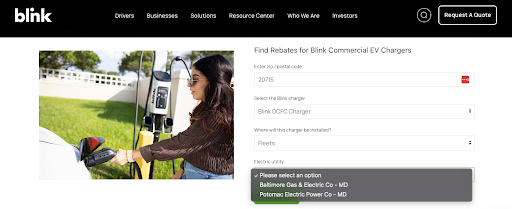 Once we have chosen the utility provider, an additional field appears asking if we are:
A business installing an EV charger
A contractor installing an EV charger
A distributor selling an EV charger
Other
For this example, we have chosen “A business installing an EV charger” to mimic a typical client experience. This causes another field to appear that asks if the charger is going to be installed in an underserved or disadvantaged community.
This field has three options, which include:
Underserved or Disadvantaged Community
No
Not sure
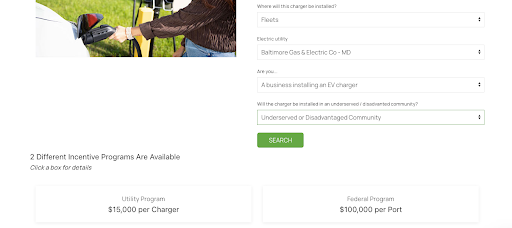 If we choose “Underserved or Disadvantaged Community,” we get two different results for this specific chain of responses:
Utility Program - $15,000 per Charger
Federal Program - $100,000 per Port
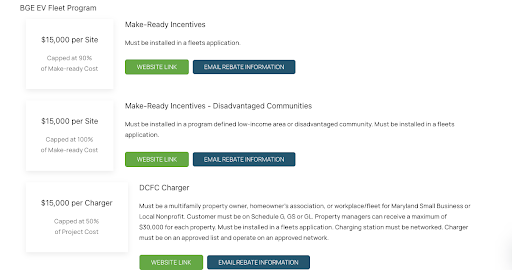
These initial results tell you the types of funding opportunities available. If we click to explore the Utility Program, it will present three final results, which provide summaries of the funding opportunities. If you want to explore a funding opportunity further, you can click on the “Website Link” button or have the information emailed to you by clicking on the “Email Information” button.
Because we chose Baltimore Gas & Electric Co (BGE) and “Fleets” for this example, we get three results from the BGE EV Fleet Program:
BGE Fleet Make-Ready Incentives
$15,000 per Site capped at 90% of Make-ready Cost
Must be installed in a fleet application.
BGE Make-Ready Incentives - Disadvantaged Communities
$15,000 per Site capped at 100% of Make-ready Cost
Must be installed in a program defined low-income area or disadvantaged community. Must be installed in a fleet application.
BGE DCFC Charger
$15,000 per Charger capped at 50% of Project Cost
Must be a multifamily property owner, homeowner's association, or workplace/fleet for Maryland Small Business or Local Nonprofit. Customer must be on Schedule G, GS or GL. Property managers can receive a maximum of $30,000 for each property. Must be installed in a fleet application. Charging station must be networked. Charger must be on an approved list and operate on an approved network.
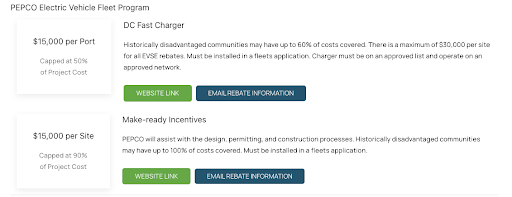
 If we change our utility provider in this example to the other available option, Potomac Electric Power Co (PEPCO), we can see the two incentive programs that PEPCO offers for fleets in a disadvantaged area as part of its PEPCO Electric Vehicle Fleet Program:
DC Fast Charger
$15,000 per Port capped at 50% of Project Cost
Historically disadvantaged communities may have up to 60% of costs covered. There is a maximum of $30,000 per site for all EVSE rebates. Must be installed in a fleet application. Charger must be on an approved list and operate on an approved network.
Make-ready Incentives $15,000 per Site capped at 90% of Project Cost
PEPCO will assist with the design, permitting, and construction processes. Historically disadvantaged communities may have up to 100% of costs covered. Must be installed in a fleet application.
 Switching over to the government side of things, the only government-backed funding we see available for our example is the Federal EV Charger Tax Credit
EV Charger Tax Credit Business
$100,000 per Port capped at 30% of Project Cost
The federal tax credit, often referred to as the 30C tax credit, can cover up to 30% of EV charger equipment and installation costs. For non-residential installations, the tax credit is up to $100,000. The equipment must be located in approved "census tract" as defined by the IRS. Customers must follow prevailing wage and apprenticeship guidelines for installation or the credit is capped at 6% of cost. Project cost includes the cost of the charger itself, installation, and equipment needed to support the charger (wall mount, conduit wiring, new electrical panel, etc). Equipment must be placed in service by June 30, 2026. You claim the credit on your Federal tax return by completing a form 8911.
There is a 25% chance that this location is in an approved census tract. Use the DOE tool to confirm eligibility by entering the full address of the property.
We will look at one more example that has some state-backed funding programs for a randomly chosen zip code in California.
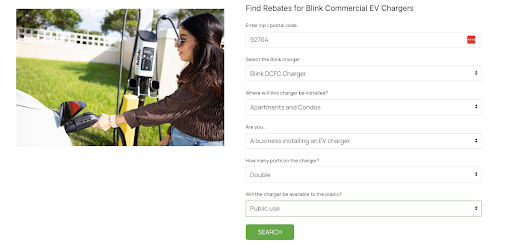
For this example, our field responses are:
Select the Blink charger
Blink DCFC Charger
Where will this charger be installed?
Apartments & Condos
Are you…
A Business Installing EV chargers
How many ports on the charger?
Double
Will the charger be available to the public?
Public use
As you can see here, because we chose “Apartments & Condos” for our installation destination, the Commercial Incentives Finder has asked for some additional information about the number of charging ports and whether the charger is open for public use or is strictly for private use. We chose Public Use for our example.
 For this example, we have three results:
A local program
A state program
The aforementioned federal program
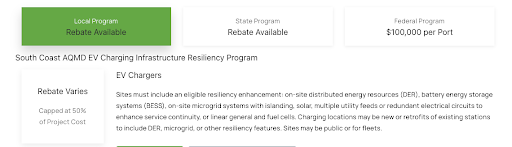
The local program is the:
South Coast AQMD EV Charging Infrastructure Resiliency Program
Capped at 50% of Project Cost
Sites must include an eligible resiliency enhancement: on-site distributed energy resources (DER), battery energy storage systems (BESS), on-site microgrid systems with islanding, solar, multiple utility feeds or redundant electrical circuits to enhance service continuity, or linear general and fuel cells. Charging locations may be new or retrofits of existing stations to include DER, microgrid, or other resiliency features. Sites may be public or for fleets.
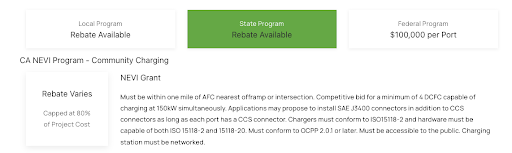
 The state program is the:
CA NEVI Program - Community Charging
Capped at 80% of Project Cost
Must be within one mile of Alternative Fuels Corridor nearest offramp or intersection. Competitive bid for a minimum of 4 DCFC capable of charging at 150kW simultaneously. Applications may propose to install SAE J3400 connectors in addition to CCS connectors as long as each port has a CCS connector. Chargers must conform to ISO15118-2 and hardware must be capable of both ISO 15118-2 and 15118-20. Must conform to OCPP 2.0.1 or later. Must be accessible to the public. Charging station must be networked.
 The federal program is the same one we looked at before.
And, just for comparison’s sake, we used the same field responses, but changed the type of charger to a Blink Level 2 charger to see what would change in the results of this California example.
We still get the same local rebate, the South Coast AQMD EV Charging Infrastructure Resiliency Program, and the same federal funding program, the EV Charger Tax Credit for Business, but instead of a state-backed funding opportunity, we get two utility rebate programs.
SCE Charge Ready - Charging Infrastructure and Rebate Program
Capped at 100% of Make-ready Cost
Commercial, Multi-family and Public Sector
SCE will design, construct, and install all of the necessary make-ready infrastructure on both the utility-side and customer-side of the meter leveraging program funding. Participants can choose to instead install the customer-side of the meter make-ready infrastructure, and qualify to receive a rebate up to 80% of SCE-estimated construction costs. Any rebates issued will not exceed the participant’s actual costs. Charging station must be networked. Charger must be on an approved list and operate on an approved network.
SCE Charge Ready - Small Site Rebate
$10,000 per Port
Capped at 100% of Project Cost
For qualifying multifamily and commercial properties. Maximum 4 ports. SCE will perform all the necessary utility-side of the meter infrastructure work. Participants must operate the chargers for 10 years. Must enroll in the Demand Response Program. Participants must have an Edison SmartConnect® meter or other SCE approved meter for registering the charging equipment load to participate in this program. Charging station must be networked. Charger must be on an approved list and operate on an approved network.
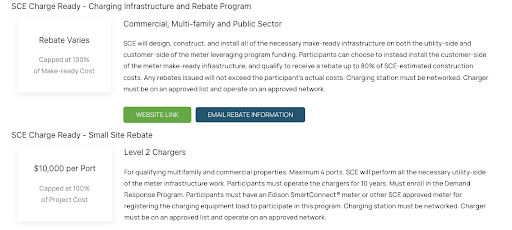 As you can see, funding opportunities can change drastically depending on what type of installation you are doing and where the installation is going. Many of these funding opportunities also have strings attached to them, like being installed in specific areas or requiring specific traits. We will go through some of the specific requirements in our examples to ensure you are fully aware of what they mean.
Underserved or Disadvantaged Community
Some of our examples were for EV chargers meant for underserved or disadvantaged communities. As the description implies, these are communities (sometimes referred to as Census Tracts) where income levels may be lower and EV charging infrastructure may be lacking. To ensure the EV charging network in the United States (which includes every publicly available and privately owned EV charger) gets distributed evenly, many grants stipulate that EV chargers be installed in these lower income neighborhoods.
Make-Ready Incentives
Not all financial incentives are for EV charger installation. Some of them are for getting parking spots ready for EV chargers without actually purchasing and installing them. A “make-ready” parking spot is one where you get it ready for EV charging installation by procuring your permits, installing the wiring and conduits, and installing other items you may need to prepare for turning that parking spot into an EV charging spot without actually hooking up an EV charger. Once you are ready, you can purchase and install an EV charger in that parking spot.
Getting parking spots ready ahead of time can save you on labor costs in the future, because labor costs often increase from year to year. It also provides you with an incentive to eventually purchase an EV charger to plug into that spot. If you’ve already made it ready for EV charging infrastructure, you may as well transition it to an EV charging space when you are ready for expansion.
Alternative Fuels Corridors
The National Alternative Fuels Corridors (AFC) are designated places for alternative fueling infrastructure, like EV chargers, that are placed along national highway system corridors to bring EV charging to places where drivers will naturally need to refuel their vehicles. The AFCs are designated by the U.S. Department of Transportation Federal Highway Administration. The federal funding we looked at requires placement of DCFCs along these AFCs.
Networked Chargers
Most funding providers will want your chargers to be networked and this is because it’s much easier to gather and disseminate data from an EV charger that is part of a network. Networked chargers can also facilitate EV roaming, which is the ability for drivers to initiate and pay for charging across all brands of EV chargers regardless of what type of mobile app or RFID (chip) card they are using. If someone is a Blink member, for example, and they have a Blink membership card, they can use that card to pay for charging on another network.
Networked Blink EV chargers are all on the Blink Network, which gives charger hosts the ability to run their chargers remotely thanks to Blink Charging’s cloud-based software. Charger hosts can also adjust the settings for their chargers, like pricing, permissions, and groups. Fleet operators get a specialized fleet portal with even more control over their chargers. The Blink Network can also generate reports about your charging network to download and/or share.
Distributed Energy Resources
In our California example, we saw references to Distributed Energy Resources. These are items like renewable energy (solar energy arrays, for example), on-site energy storage devices (more on those below), and combined heat and power (CHP) energy generation (an energy system that produces both electricity and heat from a single, on-site fuel source).
Having distributed energy resources allows a host to run their chargers using multiple sources of locally-produced energy rather than solely relying on the power grid. This can help alleviate pressure on the grid and ensure a host’s EV charging system always has available power to function.
Battery Energy Storage System
Also in our California example was reference to a Battery Energy Storage System (BESS). You can think of these systems as giant batteries. They are useful for running an EV charging system during times of peak grid demand so you don’t have to pay peak grid demand prices. Like distributed energy resources, you can also use them to ensure steady power to your EV chargers even when there is a lot of pressure on the grid for electricity.
ISO15118-2 and 15118-20
Known as “Plug & Charge” capability, ISO15118-2 is the international standard that allows EVs and EV chargers to communicate with each other to start charging and then collect payment for that charging by simply plugging the charging port into the vehicle receptacle. With ISO15118-2 Plug & Charge, there is no need for payment cards. All vehicle verification and payment is handled between the vehicle and charger automatically.
ISO15118-20 is an enhanced version of ISO15118-2 that enables bidirectional power transfer (sending power from the vehicle back to the electrical grid via the EV charger), wireless power transfer (wireless charging), automatic connection devices (ACD), and increased security measures.
OCPP 2.0.1
Open Charge Point Protocol (OCPP) is the operating system that EV chargers use. It is akin to iOS or Android for a phone. OCPP 2.0.1 is the current most recent version of it.
I have found funding opportunities. Now what?
Once you have found a funding opportunity to apply for, the next step is getting to work applying for it.
Blink Charging applies for numerous funding opportunities for our own Blink-Owned EV chargers (more on Blink Business Models, including Blink-Owned below) and therefore we have extensive experience with applying for various types of funding.
While we can offer guidance to clients about how to approach funding applications, we cannot actually fill out the paperwork for them. We have included here a short guide to dealing with government and utility funding opportunities, but you can also check out Blink Charging’s much longer and more thorough Complete Guide to Navigating EV Charging Grants and Funding.
Make sure you can afford installation upfront
The vast majority of funding is done via reimbursement. That means you have to pay for your EV charging installation upfront and then get reimbursed later. That reimbursement will likely only be for a portion of what you spend.
Be aware of deadlines
First, check the deadline. Funding opportunities from governments or utilities have deadlines for applications. These deadlines are final and you cannot try and sneak your application in any later than the time and date specified.
This type of funding also tends to have multiple rounds, so if you see you’ve missed a deadline, there might be another round of funding from that same program at a later date.
Save your work to apply for other funding
Rather than just applying to one single source of funding, try and apply for every bit of funding you are eligible for. To help with this, save all your information from when you apply for a type of funding so you can use it in other applications. This will also help you expedite future funding applications, as well.
Start utility and electrification partner coordination early
At some point in the application process you are going to need to coordinate with your utility provider. Start this process as soon as you can. Your utility provider is a key player in your EV charging installation, especially if your site requires electrical upgrades, so you will want to get the proverbial ball rolling with them early on. Same with your chosen electrification partner. Choose one early in the process and coordinate with them.
Gather your information and develop your narrative
While each grant or rebate program is different, this is the information you will generally require:
Project readiness,
Budget,
Deployment plans,
Matching funds availability,
Qualifications for building the project,
A narrative that conveys the need for the project.
Common documentation that is required includes:
Certificate of Corporate Status
W9 tax form
EV charging project plans
Letters of support (from your utility provider, vendors, contractors, etc.)
Detailed budget
Equipment specification sheets
Utility layout
Contractor quotes
Vendor quotes
Written narrative
Preparing your funding application
Read all the requirements and follow them. If there is a word count limit for a question, honor it. Applications are graded on a points system and not following directions will lose you points. Skip the marketing fluff and provide the information required succinctly. Keep in mind that the person reviewing your application may not be an EV charging expert, so answers should be prepared in a way that can be understood even by non-experts.
Many funding agencies prefer projects that are ready to go right now, so any preparation work you can do will be valuable for procuring funding. However, it is crucial to note that you cannot be reimbursed for money you spend before being approved for funding. While you do want to be prepared, also be cognizant that any money you spend pre-funding approval is a cost that you will not be getting back.
Things you can do to be prepared include:
coordinating with your local utility provider,
finding an electrification partner like Blink Charging,
researching EV charging infrastructure,
getting price quotes,
drawing up installation plans, and
potentially getting your permitting process ready to start.
Beyond Funding: Other ways to lower capital costs
You may think that installing EV charging infrastructure means buying the EV chargers yourself and having them installed, but that’s not always the case. You can certainly do EV charging infrastructure that way and it may make the most sense for you to do it that way. But, there are other ways to offload capital expenditures or at least turn them into more affordable payments.