Designing Scalable Infrastructure
Modular Hardware Deployment
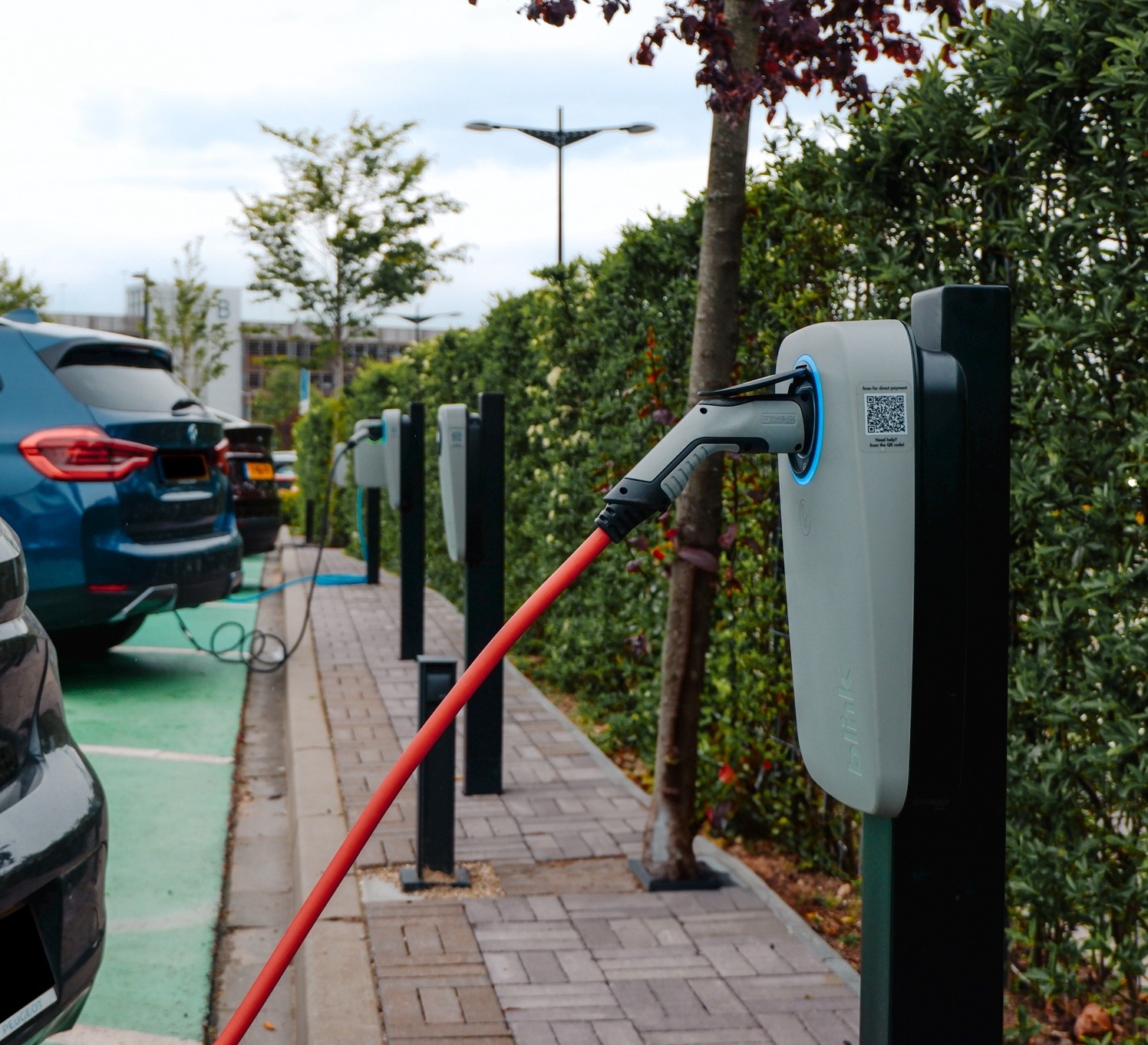
Modern EV charging hardware is built for phased rollout. Load-managed systems allow additional charge points to be added to an existing installation progressively, as demand data justifies each expansion, without requiring a new controller, a new management platform, or a break in service continuity for existing users.
The deployment model that scales most efficiently for workplace environments is a clustered one: a master charge point or power management unit handles the load intelligence and network connectivity for a group of satellite units, which can be added to the cluster at lower individual cost than standalone charge points. As a cluster approaches capacity, a new cluster is commissioned elsewhere on the site using the duct and board capacity that was reserved at first-fix. This incremental approach aligns capital expenditure with demonstrated demand rather than requiring large upfront commitments based on projections.
Power & Grid Expansion
The grid connection is the constraint that most frequently limits workplace charging expansion, and it is the one that takes the longest to resolve once it becomes binding. DNO applications for new or upgraded connections can take three to nine months to complete and involve costs that vary considerably by location and network conditions. An expansion plan blocked by a nine-month DNO lead time at the moment when EV adoption among staff has made expansion urgent is a particularly frustrating and avoidable situation.
The solution is to design the incoming electrical supply and distribution board for a larger number of charge points than are being installed initially, so that adding hardware does not require a new grid application. The specific design decisions are:
Specify the incoming supply at the capacity required for the planned mature estate, not just the first-phase installation.
Size the distribution board with spare circuit positions for future charge point circuits, protected and ready to connect.
Install cable ducts from the board to future charge point locations, capped and labelled, so that new cable runs require only draw-through rather than new civil works.
The marginal cost of each of these measures at first-fix is small. The cost of implementing any of them retrospectively is substantially larger, and is almost always accompanied by disruption to an operational car park.
Smart Charging & Load Optimisation
Scalable hardware and adequate electrical supply create the capacity for growth. Smart charging is what makes that capacity work efficiently in practice.
Dynamic load management monitors the aggregate draw across all active charge points in real time and distributes available power proportionally among active sessions. The total demand on the site's electrical supply never exceeds the capacity ceiling. Individual vehicles may receive less than the charge point's rated maximum output when the site is busy, but they all receive charge. The management system handles the allocation dynamically and invisibly, without requiring driver awareness or intervention.
For future-proofing, the significance of load management goes beyond operational efficiency. It allows a site to support more charge points on a given electrical supply than a fixed-allocation or unmanaged approach would permit, extending the scalability of the existing grid connection and deferring the point at which a DNO upgrade becomes necessary. Blink's commitment to sustainable, efficient charging technology is reflected in how its systems approach load optimisation, in line with broader sustainability goals.
Time-of-use scheduling is a further benefit of managed charging at scale. Sessions can be programmed to start at off-peak tariff periods, reducing the energy cost of the installation without requiring any change in driver behaviour. For sites with significant fleet or overnight charging, this scheduling capability can deliver meaningful reductions in the total electricity spent across the charge point estate. For more on the financial case for workplace charging, see the related article on workplace EV charging infrastructure.
The Investment Case for Getting It Right
The commercial logic of future-proofing is straightforward once the full cost picture is considered. The alternative to planned scalability is reactive expansion: installing the minimum viable installation now, then spending significantly more later to retrofit the infrastructure that should have been included from the outset, in a car park that is now occupied and operational, with all the disruption that entails.
Beyond infrastructure cost, there is a talent and culture dimension that is increasingly relevant to employers. Workplace charging is cited in employee surveys as a valued and differentiating benefit. The signal that an organisation sends by investing thoughtfully in its charging provision, planning for employee needs rather than minimum compliance, is not trivial in competitive hiring markets.
Building an EV Infrastructure That Grows With You
Blink designs workplace EV charging installations with scalability as a structural feature rather than an optional upgrade. The Blink network platform accommodates expansion from a handful of charge points to hundreds across multiple sites, without re-architecting the management infrastructure at each stage. Site design services cover power assessment, duct planning, board specification, load management configuration, and charge point layout, with future capacity headroom built in from the initial design.
For organisations reviewing an existing installation, Blink can assess what headroom remains in the current infrastructure and design an expansion plan that works within what is already in place, minimising disruption and avoiding unnecessary spend.
The decisions that determine whether a workplace charging installation ages gracefully or requires costly mid-life intervention are made early, often before the first charge point is ordered. Taking the time to make them well, with appropriate specialist input, is the most cost-effective thing an organisation can do for its long-term EV charging provision.
To find out more, visit and explore Blink's commercial charging products.