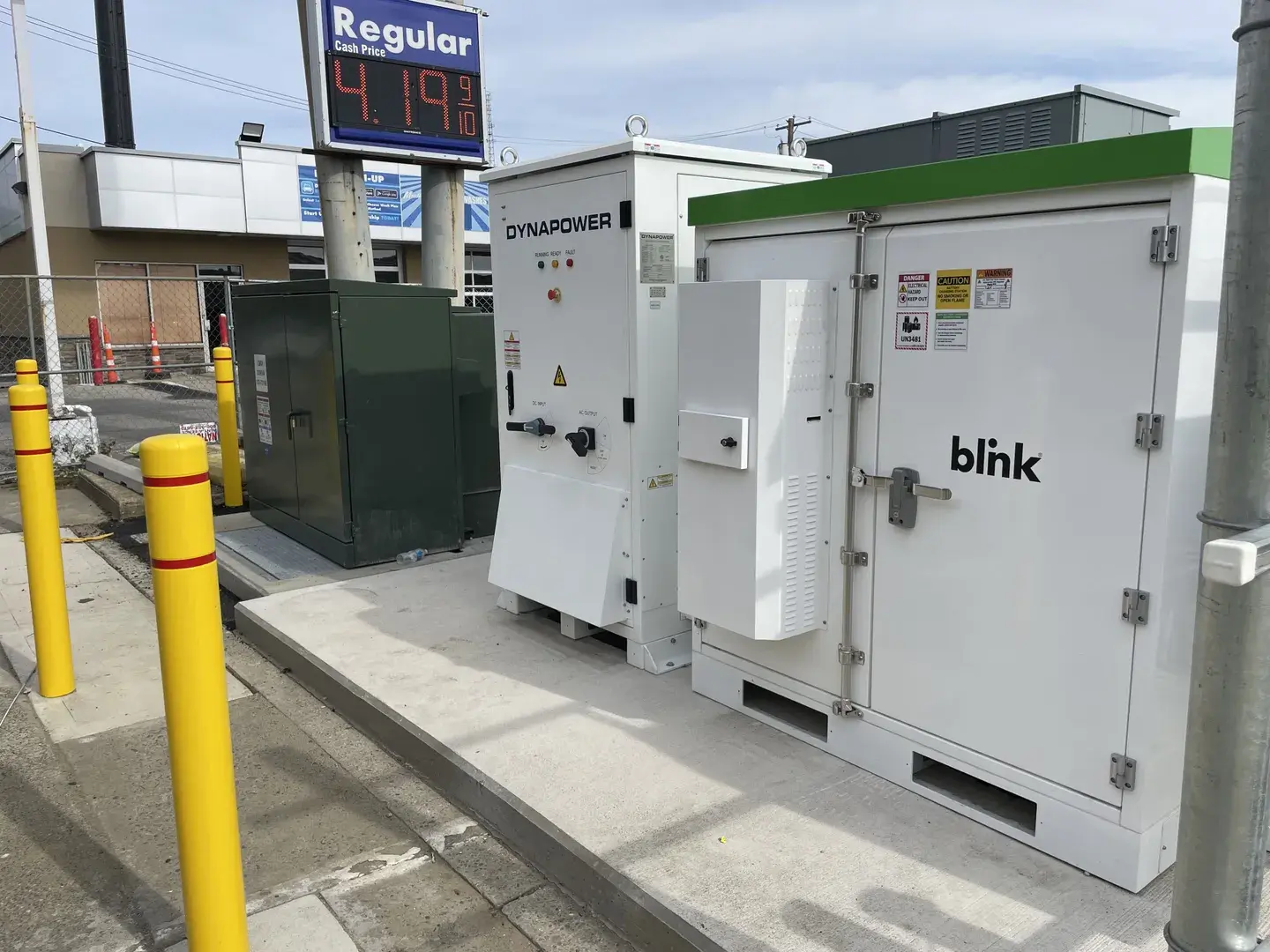
Utilities usually provide variable kilowatt-hour (kWh) pricing, distinguishing between on-peak and off-peak hours. These rates incentivize both consumers and businesses to shift non-essential electricity usage to off-peak hours. For instance, on-peak price may be $0.15 kWh, while off-peak hours could be as low as $0.11 kWh. A BESS can assist an automotive dealership in cost savings by allowing them to charge during peak times when electricity rates are at their lowest and utilize the stored energy during periods of higher electricity rates. Incorporating a BES system can aid in lowering the operational costs of a DC fast charger. Unlike Level 2 chargers that use 208/240-volt (V) input, DC fast chargers demand 480 V (often necessitating a new transformer). With BES systems, you have the flexibility to either add more chargers or reduce your utility bill when charging your fleet vehicles, customer vehicles, or your electric vehicle inventory.
BESS Sustainability
Besides reducing electricity costs for your dealership, a BES system can contribute to your sustainability goals, especially when paired with a renewable energy source such as solar power. If your energy comes primarily from renewables, the BESS enables you to store that energy for times when renewables may not be available, like at night for when solar panels are inactive. This helps avoid reliance on electricity generated by fossil fuel burning.
Additionally, certain types of BES systems contribute to the recycling of old EV batteries.
BESS Support the Electricity Grid
Considering that projected global increase in EV sales to reach 45% of all vehicle sales by 2050, charging these millions of new batteries will strain to electricity grids worldwide. Installing a BESS on-site helps alleviate this grid demand for EV charging. Consequently, it is expected to become more common for businesses and utilities to incorporate a BESS at locations with DC fast chargers and large-scale installations.
McKinsey & Company highlights EV charging as a significant factor driving the growth of the BESS market, estimating it to be worth $120 billion to $150 billion by 2030. Their analysis reveals that over $5 billion was invested in BESS in 2022, marking almost a threefold increase from 2021.
Different types of BESS
Various types of Battery Energy Storage Systems (BESS) are available, with some being more suitable for home use, while others cater to businesses like dealerships.
Vehicle-to-Grid Systems
Abbreviated as V2G or VTG, Vehicle-to-Grid energy storage and distribution systems are akin to reverse EV charging. V2G technology enables EV batteries in parked vehicles to supply electricity to the grid through a compatible charging station. This is accomplished using bidirectional electronic converters that link the electrical network to EV batteries. In a nutshell, as explained by ScienceDirect, V2G allows “EVs to adopt smart-charging methods to utilize low-cost and renewable energy when it is available and earn revenue by feeding energy back into the grid to help balance the system.”
Repurposed EV Batteries
Similar to all batteries, lithium batteries utilized in electric vehicles gradually degrade over time. Nevertheless, even when these batteries are no longer capable of powering an EV, they still retain a considerable amount of useable life. A 2015 conducted by the Lawrence Berkeley National Laboratory, which used the first generation Nissan Leaf, revealed that “power fade does not have a significant impact on an EV's drivability performance, even with substantial levels of fade down to 30% remaining power capacity. As a result, EV battery retirement will be driven by energy capacity fade rather than by power fade.” The mentioned study corrected earlier assumptions about the longevity of EV batteries, indicating that they can endure beyond the initial expectations. It also suggested the importance of further research into the utilization of batteries in their “second life”.
McKinsey identifies three ways to repurpose EV batteries:
Providing reserve energy capacity to maintain a utility’s power reliability at lower cost by displacing more expensive and less efficient assets,
Deferring transmission and distribution investments, and
Taking advantage of power-arbitrage opportunities by storing renewable power for use during periods of scarcity, thus providing greater grid flexibility and firming to the grid.
Current research is dedicated to the recycling of EV batteries, and a GlobalData report Innovation in Automotive: EV battery storage units highlights Toyota as a key player in refurbishing and reusing old EV batteries for energy storage and distribution. The report also says Toyota and Japanese utility JERA, have commissioned the Sweep Energy Storage System, comprising lithium-ion, nickel metal-hydride and lead acid cells. The Sweep Energy System aims to provide around 100,000 kWh of electricity to Japan’s grid by the mid 2020s. In addition to Toyota, Honda, Ford, and Porsche are highlighted as key players in the GlobalData report. Interestingly, a Reuters article from June 2023 humorously quoted energy industry professionals, stating due to the continued use of first-generation EVs, there aren’t sufficient used EV batteries for a second-life battery market yet. Moreover, the U.S. Department of Energy provides a grant for research and development focused on battery recycling.
Systems Built for Battery Energy Storage
Numerous Battery Energy Storage Systems (BESS) are purposefully constructed to store and distributing energy, often, employed directly by electricity providers. According to the U.S. Energy Information Administration, there are currently 429 BESS implemented at utilities nationwide, boasting a collective power capacity of 8,842 megawatts. These systems assist utilities in enhancing the balance and reliability of the electricity grid by storing and smoothing the distribution of renewable energy, thereby mitigating fluctuations. Additionally, BESS serve as temporary electrical infrastructure in areas awaiting more permanent solutions or act as backup power sources. In the second quarter of 2023, the U.S. witnessed a substantial increase in battery energy storage, primarily driven by utility providers, followed by residential homes and commercial businesses.
As per the National Renewable Energy Laboratory, the installation cost of a BESS at a commercial site is around $2,687.12 per kilowatt (kW) or $671.78 per kilowatt-hour (kWh). Thus, installing a 300kW (1,200kWh) BESS would amount to approximately $806,136. While this initial investment is significant, the BESS system has the potential to yield substantial long-term savings, especially when operating DC fast charging stations at your dealership.
Moreover, businesses meeting the criteria outlined in Inflation Reduction Act, may qualify for an Investment Tax Credit (ITC) or Production Tax Credit (PTC) when installing solar technology or a BES system.
Conclusion
In the era of electric vehicles, automakers are dedicated to EVs, requiring dealerships to invest in charging stations for the showroom, service, and back-of-house fleet. Whether crafted from new materials or refurbished EV batteries, Battery Energy Storage Systems (BESS) can assist automotive dealerships in saving money and enhancing sustainability initiatives, particularly when paired with renewable energy sources. Discover additional information about Blink’s dealership solutions.