
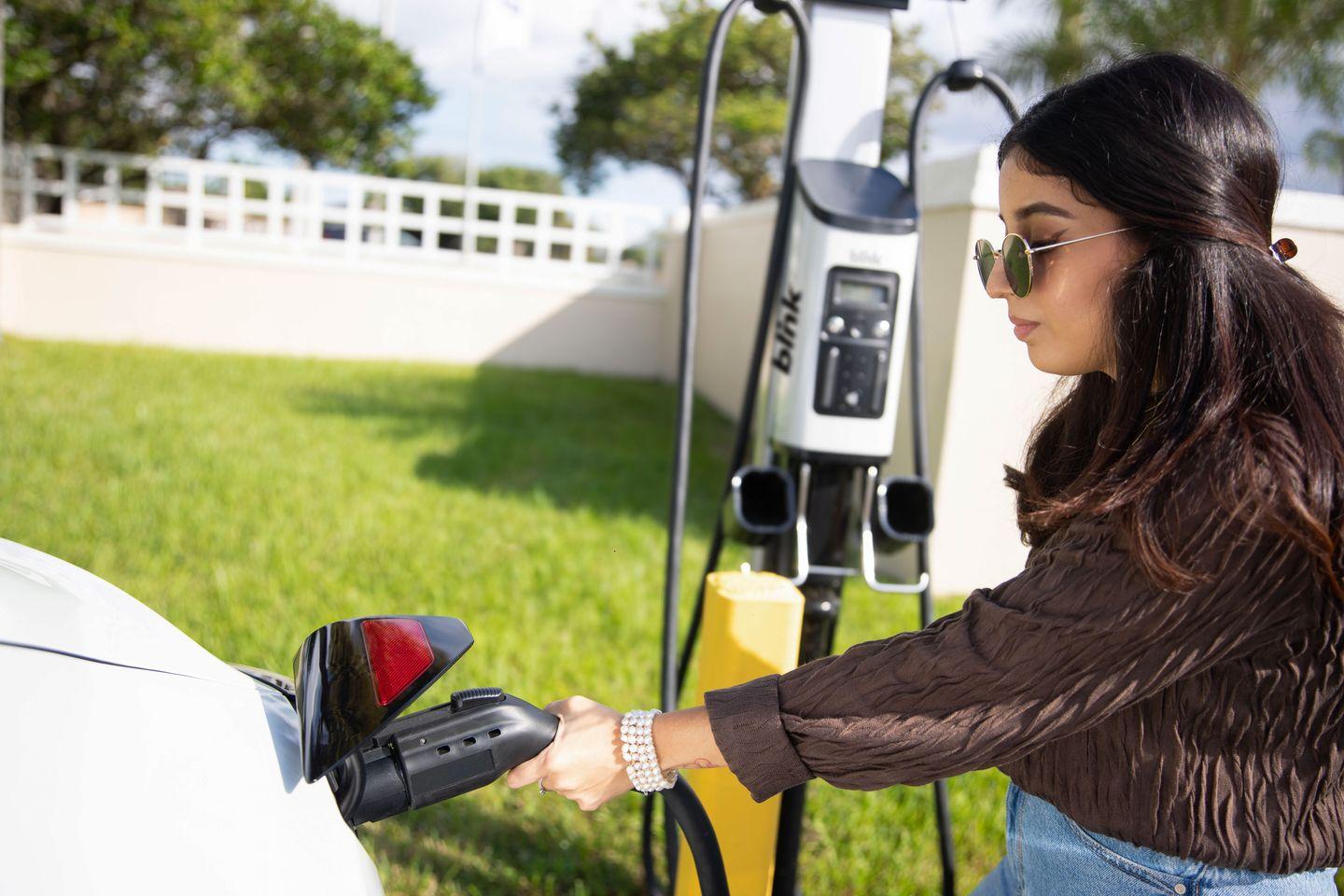
At Blink, we emphasize how easy electric vehicles are to charge — you simply plug in and go. There are three EV charger types: Level 1, Level 2, and Level 3/DCFC. Many EV drivers are concerned about what type of plug they need, whether they can use the Level 1 plug that comes with their EV, and how to charge at Level 2 and DC fast chargers.
To better understand how EV plug types have evolved and what’s available today, let’s take a close look at the history and development of charging connectors.
What You Need to Know About EV Charging Connectors
Electric vehicles have been around for more than 100 years. In those early days, types of charging plugs were limited, and EV owners used non-rechargeable batteries. EV charging stations were unheard of, and many people lacked electricity, so charging was impossible. Later in 1914, General Motors introduced DC charging stations placed in strategic places in cities.
Organizations like the National Electric Transportation Infrastructure Working Council (IWC) later defined charging levels (Level 1, Level 2, Level 3) in the National Electric Code (NEC). Another player entered the market with Tesla’s proprietary connector. While it was initially exclusive to Tesla vehicles, it's now open to other EV manufacturers.
As the EV charging infrastructure grows, understanding different EV plug types simplifies the process. The available types of charging connectors differ in design, functionality, and regional usage.
Familiarizing yourself with your vehicle's plug type helps you find a compatible connector. Let's discuss the main EV charging methods, AC (Alternating Current) and DC (Direct Current) types, and how they serve different charging needs and speeds.
AC Charging Connectors
AC charging is for slower, more convenient charging at home, work, or public places. AC charging connectors allow you to charge your vehicle overnight. With AC, a converter in the car converts the AC power from the electrical grid into DC power because the vehicle's battery requires DC power to charge.
The most common AC connectors include:
Type 1 Connector: This single-phase connector, mostly used in the USA and Japan, supports up to 7.4 kW charging.
Type 2 Connector: Widely used in Europe, this three-phase connector charges vehicles up to 43 kW, making it suitable for home and public electric vehicle charging stations.
DC Charging Connectors
DC charging is designed for higher-speed charging. Because of its ultra-charging capabilities, DC charging connectors enable you to drive longer distances in electric vehicles. DC fast charging stations charge an EV's battery from zero to 80% in about 20 to 45 minutes, much faster than AC charging methods like Level 1 and Level 2.
The main DC connectors include:
Combined Charging System (CCS): This connector supports AC and DC charging, offering high-power DC rapid charging up to 350 kW. It‘s widely used in Europe and North America, where you can use a Tesla Supercharger even with a different EV model.
CHAdeMO Connector: Primarily used in Japan, this connector supports rapid DC charging up to 50 kW.
Level 1 & 2 Chargers
In North America, all-electric vehicles use the J1772 plug for Level 1 and 2 charging, except Tesla, which has its own plug. The J1772 has been adopted by the Society of Automotive Engineers as the standard plug for Level 2 AC charging. The connector has several types of shock-prevention standards for use in rain and the elements.
Level 2 plugs differ in various parts of the world. When visiting Europe or Asia, if you rent an electric vehicle internationally, rental car companies will supply you with the proper cables to fit their EVs.
Level 1
NEMA 5-15, the standard 15 amp and 125V plugs most likely found in your home, are for large appliances, such as refrigerators and clothes dryers. These plugs work well with Level 1 chargers and charge at the slowest rate. NEMA 5-20, the 20 amp, 125-volt plug is similar, but more often found in office buildings than residences.
The cord which comes with your EV is a good choice for use with a Level 1 charger. Level 1 chargers are easy to find and use, inexpensive, and reliable. For a single-family home with a plug-in hybrid EV, a Level 1 charger may meet drivers’ needs. Level 1 chargers charge at a rate of 4-5 miles per hour. They work best if a driver is able to plug in and let the vehicle charge overnight on a regular basis. The equipment that comes with your new car will fit any Level 1 charger.
| Level 1 | |
|---|---|
| Voltage | 120V AC |
| Power output | 1kW to 1.8kW |
| Range added per hour | 4 to 5 miles |
| Connector type | SAE J1772 |
| Usage type | Home |
Level 2
Since Level 1 chargers are slow, many consumers want a Level 2 charger, which can charge at a rate of 20-65 miles per hour. EV owners who live in a single-family home who want to upgrade to a Level 2 home charger can plug into the NEMA 14-50 plug or have an electrician hardwire the station. If you don't have access to a home garage or are unable to install your own station, you can also use one of the thousands of Level 2 commercial charging stations available at workplaces, multifamily homes, retail, and other properties.
| Level 2 | |
|---|---|
| Voltage | 208 to 240V (North America), 230 to 400V (Europe) |
| Power output range | 3 kW to 19.2 kW (USA), up to 22 kW (Europe) |
| Charging speed | 10 to 75 miles |
| Charge time | 4 to 10 hours for BEVs; 1 to 2 hours for PHEVs |
| Connector types | Type 1 (SAE J1772), Type 2 (Mennekes), GB/T AC |
| Typical locations | Home and workplace |
DC Fast Charging
Although not all EVs come with DC fast charging as a standard feature, it’s well worth the investment. DC fast charging stations can charge a fully electric EV up to 80% in 30 minutes, making it ideal for highway and interstate applications. However, DCFC plugs are not standardized. There are currently three types of DC fast charger plugs: CHAdeMO, SAE Combo (CCS), and Tesla/NACS. The good news for EV drivers is many DC fast chargers have both the CHAdeMO and CCS plugs available for use, ensuring you can charge and be on your way at a DC fast charging station.
CHAdeMO
The CHAdeMO plug is for use at DC fast chargers and is compatible with Nissan, Mitsubishi, Kia, Fuji, and Toyota. However, this electric vehicle plug type is being phased out to be replaced by CCS.
| Power output | 62.5 kW to 500 kW |
|---|---|
| Voltage rating | Up to 500V |
| Current rating | 25A to 125A |
| EV charging level | Level 3 |
| Primary regions | Japan and Europe |
SAE Combo (CCS)
Quickly becoming the industry standard, the SAE Combo (CCS) is to be used at DC fast chargers for all upcoming U.S. and European EVs, BMW, Volkswagen, Chevy, and some Asian electric vehicles.
| Maximum power output | Up to 350kW |
|---|---|
| Voltage range | Up to 1000V |
| Current range | Up to 500A |
| Compatibility | AC and DC charging |
| Region | Europe, Asia Pacific |
North American Charging Standard (NACS)
Tesla created a proprietary plug for charging their electric vehicles. The Tesla plug was initially only available at Tesla charging stations, which meant that drivers with any EV other than Tesla needed to charge at another company’s Level 2 or DC fast charging station.
However, in 2022, Tesla opened its proprietary connector to other manufacturers, which has been renamed North American Charging Standard (NACS) plug. Here are the latest updates on Tesla and NACS standardization:
In 2023, several automakers including Ford and General Motors announced that they would offer NACS plugs on upcoming vehicles.
In May 2023, the Federal Highway Administration (FHWA) published requirements that allowed for all NEVI chargers with CCS connectors to also have NACS adapters.
In October 2024, the Society of Automotive Engineers announced that the standardized version of the Tesla/NACS plug would be called the SAE J3400.
In December 2024, the FHWA teased another announcement for federal standardization of the new SAE J3400 plug.
| Max DC power output | Up to 1 MW |
|---|---|
| Output current type | AC and DC |
| Max output current | 48Amps AC, 400Amps DC |
| EV charging levels | Level 2 and Level 3 |
| Regions | U.S. and Canada |
How to Determine the Right Type of Charging Plug
Although there are different EV charging plugs, choosing the right one doesn't have to be complicated. You can first check your EV charging port to find a compatible connector. You should also consider the following to get the right EV charger plug type:
Region: EV Plug types vary by region. In North America, you'll mostly find Type 1 (AC), CCS1 (DC), and Tesla NACS. In Europe, you'll find Type 2 (AC) and CCS2 (DC), and in Japan, you'll find CHAdeMO (DC).
Vehicle manufacturer preferences: Japanese brands often use CHAdeMO for DC charging. European brands prefer Type 2 for AC and CCS for DC charging, while Tesla uses NACS in North America and CCS2 in Europe.
Charging station compatibility: Public charging stations display supported electric vehicle charging plug types. Match your vehicle’s port to the station’s connector options.
Identifying the correct electric vehicle charging plug ensures compatibility with charging stations and optimizes your charging experience. Understand the EV charging plug types and their characteristics to determine which connector your vehicle uses and plan your charging sessions.
Power Your EV with Blink
Blink utilizes the most advanced technology available to ensure cars using our charging stations can charge quickly and safely. Blink chargers can be used with all EVs. Depending on the market and type of charger, Blink's solutions include J1772 chargers, NACS chargers, CCS chargers, and more.
Learn more about Blink's charging solutions or contact us for your quote today!