
Skip to Main Content

ESG

Blink is committed to sustainability.Learn More

EV Charging at Work: A Practical Employer Guide

Posted 25/02/2026

Electric vehicles are now a normal sight in UK workplace car parks. What began as early adoption has moved firmly into mainstream behaviour. As more employees choose electric vehicles, employers are increasingly being asked whether they provide EV charging at work and, if so, how it operates.

For employees driving electric cars, access to a workplace EV charge can influence their decision to adopt an electric vehicle in the first place. Charging at work is increasingly seen as a practical commuting benefit, particularly where home vehicle charging is not possible. As organisations respond, installing EV chargepoints is becoming part of long-term sustainability goals rather than a short-term gesture.

For many organisations, charging electric vehicles at work began with good intentions and limited demand. A small number of chargepoints were installed to support early adopters. Over time, usage grew. Questions followed. Who can use the chargers? Is charging free? How long can someone stay plugged in? What happens when demand exceeds supply?

EV charging at work is no longer just a sustainability gesture. It is workplace infrastructure. It affects employee experience, facilities management, operational cost control and long-term planning.

This guide explains how EV charging workplace environments operate in practice, what responsibilities employers hold, how to manage access fairly, what safety and compliance considerations apply, and how to structure charging in a way that remains scalable and sustainable.

For an overview of Blink’s structured workplace EV charging solutions, visit our Workplace EV Charging Guide or our Workplace Charging Solutions.

How EV Charging at Work Operates

At its simplest, EV charging at work involves an employee parking their vehicle in a designated charging bay, connecting the cable and initiating a session through authentication. However, behind this simple process sits a structured system that ensures charging aligns with site capacity and workplace policy.

Most workplace charging installations use AC chargers rated between 7 kW and 22 kW. These are well suited to typical office dwell times, where vehicles remain parked for several hours. In many cases, a full working day is more than sufficient to replenish daily commuting range.

Most office installations consist of networked EV chargepoints, each with an individual chargepoint socket that connects directly to the vehicle. Once a charging point is installed, it becomes part of a wider managed system that controls access, monitors vehicle charging sessions and ensures power capacity is not exceeded.

Electric vehicle charging in the workplace is therefore not just about hardware. It is about ensuring that each EV chargepoint operates within clearly defined parameters.

Charging electric vehicles at work usually follows this sequence:

  1. Driver parks in a marked charging bay

  2. Driver authenticates via RFID card or app

  3. Charging session begins according to site rules

  4. Session ends automatically or when vehicle reaches target charge

  5. Usage data is recorded for reporting

In structured EV charging workplace environments, chargers are connected to a management platform. This software layer enables facilities teams to oversee performance and usage. It ensures charging does not exceed available electrical capacity and provides transparency around energy consumption.

Depending on the employer’s approach, charging may be:

Provided free as an employee benefit

  • Subsidised at a reduced rate

  • Charged at cost recovery

  • Priced at a defined tariff

The important point is not which pricing model is chosen, but that it is clearly communicated and consistently applied.

Why EV Charging at Work Is Increasingly Expected

As EV ownership grows, employees increasingly assume that charging at work will be available. For those without home charging access, the workplace can become a critical charging location.

Charging electric vehicles at work removes one of the biggest barriers to EV adoption: range anxiety. Employees gain confidence knowing they can top up during the working day.

Beyond convenience, EV charging workplace infrastructure signals that an organisation is forward-thinking. It demonstrates support for sustainable commuting and can positively influence recruitment and retention.

From an operational perspective, providing EV charging at work also supports company fleet electrification. Pool cars, service vehicles and company vans can charge on site, reducing reliance on public charging networks.

Workplace charging therefore sits at the intersection of employee experience, facilities management and fleet operations.

For some employees, the availability of workplace EV charging can also have financial implications. Company car drivers may evaluate benefit in kind tax considerations when selecting electric vehicles, and access to charging at work can strengthen the overall case for electrification.

Employer Responsibilities When Charging Electric Vehicles at Work

Once EV charging is installed, employers assume responsibility for how it operates.

Safe Installation and Maintenance

Employers should also be aware of previous and current funding initiatives administered by the Office for Zero Emission Vehicles. Under earlier versions of the Workplace Charging Scheme, eligible businesses could claim the grant for up to £350 per chargepoint installed, subject to eligibility criteria. Although schemes evolve over time, understanding available support and application timelines, including requirements such as installation within 180 days of approval, remains relevant when planning infrastructure.

Where applicable, businesses should assess whether they meet eligibility criteria before proceeding and ensure they claim the grant within the required timeframe.

All EV charging workplace installations must comply with UK electrical standards. Employers should ensure installations are carried out by qualified professionals and that certification is retained.

Ongoing maintenance is equally important. Chargers should be inspected periodically, and any faults addressed promptly. A charger that frequently fails undermines confidence and creates frustration.

Many organisations incorporate EV charging into their preventative maintenance schedule rather than treating it as an isolated system.

Clear Charging Policy

Charging electric vehicles at work without a defined policy quickly creates inconsistency.

A workplace EV charging policy should address:

  • Eligibility

  • Pricing structure

  • Maximum session durations

  • Expectations around moving vehicles

  • Consequences of misuse

Clear policy removes ambiguity and reduces conflict.


“Workplace charging works best when it is treated like any other shared resource. Clarity prevents conflict.”

- Tony Amaya, Director of Commercial Sales

Ownership and Governance

One of the most overlooked elements of EV charging at work is internal ownership. Charging often sits between facilities, HR, finance and sustainability teams. Without clear accountability, issues can be overlooked.

Successful organisations define who owns:

  • Charger oversight

  • Policy enforcement

  • Cost tracking

  • Expansion planning

This clarity ensures that charging electric vehicles at work remains structured as demand increases.
Managing Fair Access and Growing Demand

In the early stages, EV charging at work may operate informally. As demand grows, fairness becomes central.

Structured Access Control

Modern EV charging workplace systems use authentication tools such as RFID cards or app-based login. This allows employers to track usage and prevent unauthorised access.

Platforms such as the Blink Network enable administrators to manage access and review session data.

Rotation and Time Limits

When charger numbers are limited, rotation policies may be required. Employers often introduce:

  • Maximum charging windows

  • Automated session cut-offs

  • Notifications prompting drivers to move vehicles

These measures prevent single users from monopolising infrastructure.

Communicating with Employees

Clear communication is particularly important in environments where EV charging supports both employees and visitors. Policies should define whether visitor vehicle charging is permitted and how access is prioritised during peak periods.

Charging at work must feel fair and transparent to all users.

“Technology matters, but communication is what keeps workplace charging running smoothly.”

- Tony Amaya, Director of Commercial Sales

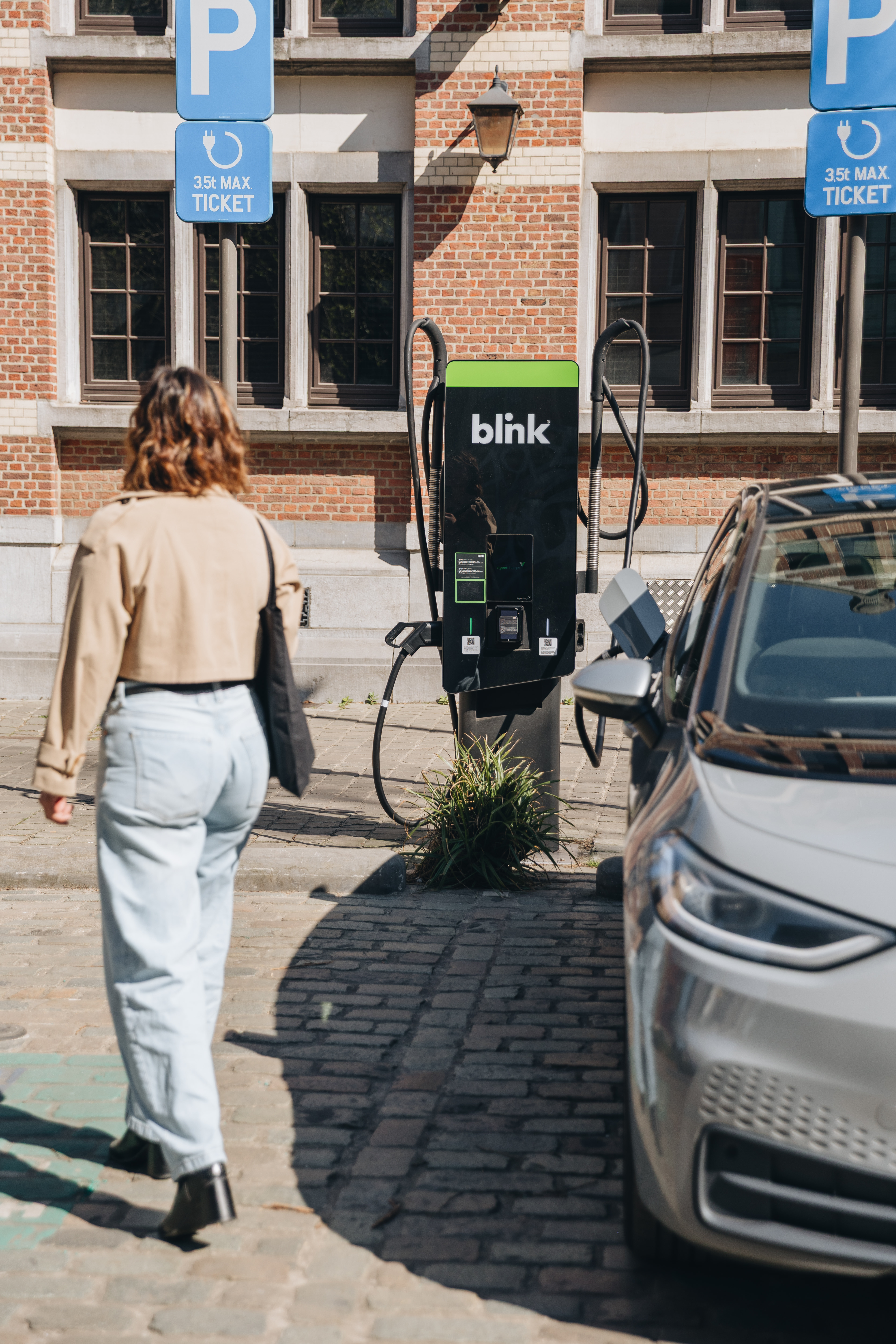
A woman walks past a parked electric car charging at a Blink station on a cobblestone street with building and parking signs in the background.

Health, Safety and Compliance Considerations

Safety is a core component of EV charging workplace environments.

Electrical Safety

Installations must meet current wiring regulations and be installed by qualified contractors. Employers should retain documentation and ensure systems are regularly checked.

Physical Layout

Charging bays should be clearly marked and positioned to minimise obstruction. Cables must not create trip hazards. Adequate lighting supports safe use during darker months.

Fire Risk and Monitoring

While EV charging is safe when installed correctly, monitoring provides reassurance. Networked systems allow faults to be detected quickly and chargers to be taken offline if necessary.

By embedding EV charging at work within broader facilities management processes, employers reduce risk and maintain compliance.

Infrastructure Planning and Scalability

When evaluating installation costs and the costs of installing additional infrastructure later, early planning becomes critical. A site that initially installs four chargers may ultimately require 40 sockets over time. Designing ducting, cabling and distribution capacity from the outset reduces disruption and protects long-term capital investment.

Each charging point installed should be considered part of a phased growth strategy rather than a standalone asset.

Employers should consider:

  • Available electrical capacity

  • Future vehicle adoption trends

  • Cable routing for expansion

  • Software capability to support additional chargers

Blink’s workplace EV charging solutions are designed to scale as demand increases. Smart load management allows employers to maximise existing capacity before upgrading infrastructure.

Employee EV Charging vs Home Charging: Why the Workplace Still Matters

Some employers assume that as home charging becomes more common, the importance of EV charging at work will decline. In reality, the workplace remains a critical charging location for a significant proportion of employees.

Not all employees have access to off-street parking. Those living in flats, shared housing or urban environments may rely heavily on public charging infrastructure. For these employees, charging electric vehicles at work provides reliability and convenience that public charging cannot always guarantee.

Even for employees who can charge at home, workplace charging provides flexibility. It allows drivers to:

  • Top up during colder months when range decreases

  • Avoid peak home electricity tariffs

  • Reduce reliance on public rapid charging

  • Manage longer commutes more comfortably

From an employer perspective, EV charging workplace infrastructure supports broader adoption of electric vehicles among staff. When charging availability improves, employees who were previously hesitant may feel more confident making the switch.

Workplace charging therefore complements home charging rather than replacing it. Together, they create a balanced ecosystem that supports widespread EV adoption.

The Financial Considerations of EV Charging at Work

Cost is often one of the first concerns raised by employers considering EV charging at work. While installation involves upfront investment, long-term financial management is equally important.

Employers typically consider three financial elements:

Installation and Infrastructure Costs

Installation costs vary depending on groundworks, electrical upgrades and charger specification. The cost of installing a single EV chargepoint may be relatively modest, but site-wide deployment requires careful budgeting. Employers must consider both immediate installation costs and the long-term costs of installing additional EV charging capacity as demand grows.

Where grants are available, businesses should evaluate whether they are eligible to claim the grant and ensure all documentation requirements are satisfied before installation proceeds.

Energy Costs

Electricity used for charging electric vehicles at work must be managed carefully. Even when charging is offered free to employees, energy consumption should be monitored to understand impact.

Software platforms such as the Blink Network allow employers to track energy usage per session and per user. This visibility supports informed decision-making around pricing policies and cost recovery.

Cost Recovery Models

Employers typically choose one of the following approaches:

  • Provide free charging as a benefit

  • Subsidies charging below public market rates

  • Charge at cost recovery

  • Apply a small margin to cover operational overhead

There is no universal correct model. The key is transparency and alignment with organisational values.

Clear pricing policies reduce confusion and ensure EV charging workplace infrastructure remains financially sustainable.

Preparing for Long-Term EV Adoption Trends

EV adoption in the UK continues to increase year on year. As battery technology improves and more models enter the market, it is reasonable to expect further growth in employee EV ownership.

Forward-thinking employers recognise that EV charging at work is not a short-term initiative. It is part of a long-term shift in mobility.

Preparing for this shift involves:

  • Monitoring current utilisation trends

  • Gathering employee feedback

  • Reviewing charger-to-vehicle ratios annually

  • Planning phased infrastructure expansion

  • Evaluating power capacity regularly

Organisations that revisit their workplace EV charging strategy periodically are better positioned to respond to rising demand.

There is also a reputational dimension. As more businesses advertise EV charging as part of their sustainability credentials, sites without infrastructure may begin to feel outdated.

Blink’s workplace EV charging solutions are structured to support this long-term evolution, allowing infrastructure and software to scale in line with adoption.

EV charging workplace infrastructure increasingly forms part of corporate sustainability goals. Accurate reporting on electric vehicle charging usage allows organisations to demonstrate measurable progress in emissions reduction. Data from each EV chargepoint supports ESG reporting and strengthens the business case for further electrification.

Electric vehicle charging is therefore not only operational infrastructure, but strategic infrastructure.

Integrating Workplace and Fleet Charging

Many organisations operate both employee charging and company vehicles. Charging electric vehicles at work therefore intersects with fleet strategy.

When workplace and fleet charging operate independently, complexity increases. Integrated systems simplify oversight.

Blink’s EV fleet charging solutions integrate with workplace charging infrastructure, enabling unified control across sites.

This coordination allows employers to prioritise operational vehicles while maintaining fair access for employees.

The Practical Reality of EV Charging at Work

In practice, EV charging at work is about balance. It requires balancing fairness with flexibility, infrastructure with budget, and immediate demand with long-term planning.

Organisations that treat workplace EV charging as a structured system rather than an informal perk tend to see smoother adoption and fewer operational challenges.

Charging electric vehicles at work is becoming part of everyday workplace life. When managed thoughtfully, it enhances employee confidence, supports sustainability commitments and prepares organisations for continued electrification.

With the right infrastructure, clear policy and reliable management tools, EV charging workplace environments can operate smoothly today and remain adaptable tomorrow.

Share this post