
Skip to Main Content

ESG

Blink is committed to sustainability.Learn More

Workplace EV Charging Costs, Grants & ROI

Posted 27/03/2026

The UK's transition to electric vehicles is accelerating. With the 2035 ban on new petrol and diesel car sales on the horizon and employee expectations shifting, workplace EV charging is no longer a nice-to-have, it's a strategic asset. Yet for many employers, the investment case still feels unclear. How much does it actually cost? What funding is available? And when does it start paying for itself?

This guide answers those questions directly. Whether you're a finance director weighing up capital expenditure, an HR leader building a benefits package, or a facilities manager planning infrastructure, you'll find the numbers, and the narrative you need to make a confident decision.

How Much Does Workplace EV Charging Cost?

Workplace EV charging cost varies significantly depending on charger type, site readiness, and the scale of your installation. Understanding the key variables upfront prevents budget surprises and helps you plan a phased rollout that keeps capital expenditure manageable.

Hardware Costs

The two most common charger categories for workplace settings are:

  • AC (alternating current) chargers: 7kW or 22kW units, typically priced between £500 and £1,500 per unit. These are well-suited to employee parking where vehicles sit for six to nine hours during a working day. A standard 7kW charger can add approximately 40 miles of range per hour of charging, more than enough to fully replenish the average commuter's battery during a shift.

  • DC rapid chargers: 50kW+ units designed for faster turnaround, often used in fleet depots or visitor bays. Hardware costs typically start from £10,000 and can exceed £30,000 for ultra-rapid units. For most staff carparks, AC charging offers a better cost-per-socket outcome.

Installation Costs

Installation is often the largest single line item in a workplace charging budget, and the one most dependent on site-specific factors. Typical installation costs per charger point run between £300 and £1,500, but can climb considerably higher where:

  • Electrical supply needs upgrading: older buildings may require a new Distribution Board or increased supply capacity from the DNO (Distribution Network Operator).

  • Trenching or cabling runs are long: car parks set away from the main building can require significant groundwork.

  • Smart load management infrastructure is needed: to prevent peak demand charges and grid stress, smart systems that dynamically distribute power across multiple charge points are often essential at scale.

As a broad planning benchmark, a 10-socket AC installation at a prepared site with adequate existing supply might total £8,000-£20,000 in combined hardware and installation costs before any grants are applied. A 20-socket deployment, or one requiring supply upgrades, could range from £25,000-£60,000+.
Planning Tip
Site surveys are free with Blink. Our team assesses your existing electrical infrastructure, car park layout and load capacity before any commitment, giving you accurate cost projections, not ballpark estimates. Request your site survey via our Request a Quote page.
Cost ComponentTypical Range
AC Charger Hardware (per unit)£500 - £1,500
DC Rapid Charger Hardware (per unit)£10,000 - £30,000+
Installation Labour (per point)£300 - £1,500
Electrical Supply Upgrade£2,000 - £15,000+
Network Setup / Smart System£500 - £5,000
Total: 10-socket AC site (prepared)~£8,000 - £20,000

Grants & Incentives for Workplace Charging

The good news: the UK government significantly subsidises workplace EV charging costs through a suite of targeted grants and tax reliefs. Used correctly, these can cut your net outlay by 40–75% before you see a single penny of operational return.

Workplace Charging Scheme (WCS)

The Workplace Charging Scheme (WCS), administered by OZEV (Office for Zero Emission Vehicles) and the DVLA, is the primary grant available to UK employers installing EV charge points for staff and fleet vehicles.

Key facts for 2025/26:

  • Covers up to 75% of the combined purchase and installation cost of each socket, inclusive of VAT.

  • Currently capped at £350 per socket, rising to £500 per socket for installations completed from 1 April 2026.

  • Maximum 40 sockets per applicant across all sites, representing a potential grant value of up to £20,000 from April 2026 onwards.

  • The scheme has been extended until 31 March 2027, but given this has been described as a 'final year' extension, organisations should not assume further renewal.

  • Available to businesses, registered charities and public sector organisations. Sole traders cannot apply.

  • Chargers must be installed by an OZEV-authorised installer using OZEV-approved equipment.

  • The WCS can be used alongside the EV Infrastructure Grant for Staff and Fleets (which covers enabling works like cable runs and distribution board upgrades), subject to no double-claiming on the same charge points.

The application process is straightforward: apply online through the government portal, receive a digital voucher code, then present it to your chosen OZEV-authorised installer. The installer claims the grant on your behalf after installation - reducing your final invoice directly rather than requiring reimbursement.

Act Before April 2026 or Plan to Benefit from It
Installations completed before 31 March 2026 attract the current £350 cap; those completed from 1 April 2026 qualify for the increased £500 per socket. If you're planning a larger installation, timing your phased rollout around this uplift could meaningfully reduce net cost. Blink's team can help you plan accordingly

Tax Reliefs & Capital Allowances

Beyond the WCS, several tax mechanisms further improve the economics of workplace EV charging:

Full Expensing (100% First-Year Allowance)

Since April 2023, companies subject to corporation tax can claim full expensing on qualifying plant and machinery, including EV charging infrastructure. This means the full cost of your installation can be offset against taxable profits in the year of expenditure, providing immediate tax relief equivalent to 25% of the net cost for a standard-rate taxpayer.

Benefit in Kind (BIK) Zero Rating on Employer-Provided Charging

Where an employer provides free EV charging at the workplace to employees, this currently attracts a zero Benefit in Kind tax rate, meaning no NIC or income tax liability for the employee, and no Class 1A NIC for the employer. This is a significant differentiator versus other employee benefits and substantially increases the real-world value of the provision.

Enhanced Capital Allowances (ECAs)

Certain energy-efficient technologies, including smart EV charging infrastructure, may qualify for Enhanced Capital Allowances, allowing 100% first-year offset. This is worth reviewing with your tax adviser, particularly for larger installations where the tax timing benefit is material.

Note: Tax treatment depends on your individual circumstances and entity structure. Blink strongly recommends consulting a qualified UK tax adviser before finalising your investment case.

Calculating ROI for Employers

EV charging ROI at workplaces is more nuanced than a simple payback calculation, but it is entirely quantifiable. The framework below separates direct financial returns (revenue and cost savings) from indirect value drivers (talent, compliance, ESG), which together build the full investment case.

Direct Financial ROI

1. Charging Revenue (Paid Models)

If you elect to charge employees or visitors a fee to use your chargers, the revenue can be substantial. At a mid-market rate of around £0.30/kWh (versus a typical grid wholesale cost closer to £0.10-0.15/kWh in off-peak periods), a 7kW charger used for 6 hours per working day generates approximately £1.26 per session, or roughly £315 per charger annually assuming 250 working days. Across a 10-socket installation, that's approximately £3,150/year in gross revenue, before network management fees.

2. Reduced Employee Attrition Costs

Replacing an employee costs the average UK employer between £12,000 and £30,000 once recruitment, onboarding and lost productivity are factored in. Workplace EV charging consistently ranks as one of the top workplace benefits sought by EV-driving employees. If offering charging retains even one employee who would otherwise have left, the ROI of your entire installation can be justified in a single year.

3. Fleet Cost Savings

For employers running electric fleet vehicles, charging at the workplace rather than via public networks significantly reduces per-mile energy costs. Public rapid chargers in the UK typically cost £0.50-0.80/kWh; workplace AC charging, particularly when paired with smart scheduling and off-peak tariffs, can achieve effective rates as low as £0.10-0.15/kWh. For a fleet covering 100,000 miles per year, that differential alone represents £5,000-£13,000 in annual fuel cost savings.

Worked Example: 10-Socket AC Installation

ItemFigure
Total installation cost (before grants)£18,000
WCS Grant (40 sockets, but 10 used here @ £350)~£3,500
Net Capital Cost£14,500
Full Expensing Tax Relief (@25% corp tax)~£3,625
Net Effective Cost~£10,875
Annual Charging Revenue (10 chargers, £315/yr each)+£3,150
Simple Payback Period~3.5 years
Year 5 Net PositionPositive (~£4,875 ahead)

These projections are conservative and exclude indirect value. With the April 2026 grant increase (£500/socket), the payback period shortens further.

Smart Charging and Load Management

One often-overlooked ROI lever is smart load management. By dynamically distributing available power across charge points, prioritising vehicles that need charging most urgently, shifting load to off-peak tariff periods, and preventing demand peaks that trigger expensive grid charges, smart systems can reduce the operational electricity cost of a charging installation by 20-40%. Blink's networked charge points integrate directly with our management platform, giving you visibility and control over energy consumption in real time.

Indirect Financial & ESG Benefits

The full return from workplace EV charging extends well beyond revenue and tax. Employers who have installed charging infrastructure consistently report meaningful advantages across four areas:

Talent Attraction and Retention

EV ownership in the UK has surpassed 1.1 million vehicles and is growing rapidly. For employers in competitive talent markets, particularly in commercial real estate, healthcare, and education. Workplace charging is increasingly a threshold benefit: employees who drive EVs actively choose employers who provide it. Research indicates that 88% of consumers look for EV charging as an amenity, a figure that reflects a broader shift in expectations about what progressive employers should offer.

ESG Reporting and Net Zero Commitments

For organisations with formal ESG reporting obligations or net zero targets, workplace EV charging contributes directly to Scope 3 emissions reduction, specifically employee commuting and business travel emissions. As investor and regulatory scrutiny of ESG disclosures intensifies, the ability to evidence tangible infrastructure investment in emissions reduction carries increasing financial and reputational value.

Planning and Regulatory Compliance

Part S of the Building Regulations (England) now requires EV charging infrastructure in new non-residential buildings with more than ten parking spaces, and in buildings undergoing major renovation. Installing proactively, rather than reactively avoids the higher costs associated with retrofit work and positions your organisation ahead of further regulatory tightening, which most industry observers expect in the coming years.

Property Value and Leaseability

For commercial property owners and landlords, EV charging infrastructure increasingly influences tenant decisions. Buildings without charging infrastructure face longer vacancy periods and pressure on rents as occupiers, particularly those with sustainability commitments, prioritise EV-ready premises. The capital cost of installation is typically reflected in improved yield and lower void rates.

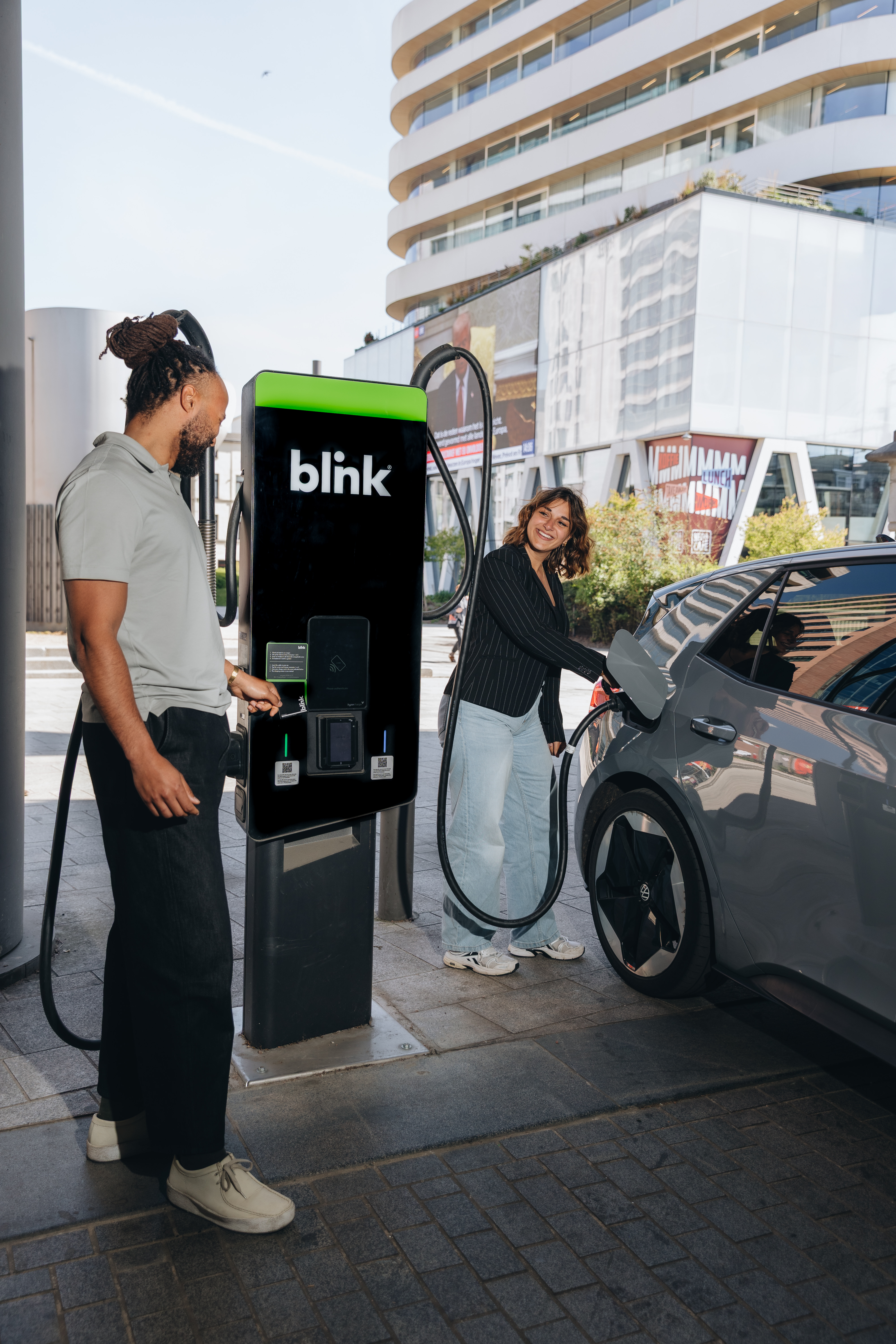
Two people charging an electric car at a Blink charging station outdoors, in a modern urban setting.
ESG in Practice
Blink's management platform generates usage reports and carbon displacement data that can be fed directly into ESG disclosures and sustainability reports, saving your team time and improving the quality of your reporting. Learn more about our services at blinkcharging.com/en-gb/host-a-charger/services-home

Blink's Cost & ROI Support

At Blink Charging UK, we understand that the financial case needs to be watertight before a board approves capital expenditure. That's why our support model is built around making the cost, grant and ROI picture as clear as possible, before you spend a pound.

Free Site Survey and Cost Assessment

Our team conducts a no-obligation site assessment covering your existing electrical infrastructure, car park configuration, likely installation costs and the grants you qualify for. You receive a detailed cost estimate, not a vague range, to take into your planning process. Request your survey here.

Grant Application Support

As an OZEV-authorised installer, Blink manages the Workplace Charging Scheme application process on your behalf, handling the paperwork, claiming the grant against your invoice and ensuring you don't leave funding on the table. We can also advise on combining WCS with the EV Infrastructure Grant for Staff and Fleets where applicable.

Flexible Commercial Models

We offer a range of deployment and ownership models. From outright purchase to network partnership arrangements to match your capital position and long-term ambitions. Whether you want to own your infrastructure outright or prefer a lower-upfront-cost model, we structure the commercial terms around your business.

Ongoing Network Management and Reporting

Post-installation, our smart charging platform gives you live visibility of usage, energy consumption, revenue and carbon displacement data. Smart load balancing minimises your electricity costs; automated reporting saves your team hours of manual work each month.

Industry-Specific Expertise

We work across a broad range of sectors, from fleet operators and government agencies to healthcare providers and educational institutions. Our team understands the unique procurement, compliance and budget constraints that apply in each context, and structures solutions accordingly.

The Employers Who Move First, Win

Workplace EV charging is not a cost to be minimised, it's an investment to be optimised. The combination of government grants that slash upfront expenditure, tax reliefs that accelerate payback, and a growing stack of direct and indirect financial returns means that well-planned workplace charging consistently delivers positive ROI within three to five years, often sooner.

The employers who move now benefit from the most favourable grant environment the UK has offered, including the forthcoming uplift to £500 per socket from April 2026. Those who delay face higher net costs, tighter regulatory timelines and the risk of losing EV-driving talent to organisations that have already invested.

Blink Charging UK exists to make that investment as straightforward and financially sound as possible, from the first site survey to the final ESG report. Talk to our team today to understand exactly what workplace charging would cost your organisation, and what it could return.

Share this post