Defining Access and Eligibility
The access model an organisation chooses should reflect both the current state of EV ownership among staff and the likely trajectory of adoption over the next three to five years. A model that works at five percent adoption may need to be redesigned at thirty percent, so it is worth building the policy with that evolution in mind.
The most commonly used access frameworks are:
Open access for all employees with personal EVs: Appropriate where demand is comfortably below capacity. Simple to administer and well-received by staff. The disadvantage is that it offers no mechanism for managing demand when charging becomes popular, so the policy should specify the trigger conditions under which a more structured access model will be introduced.
Needs-based prioritisation: Priority access for employees without home charging capability, typically those in flats or properties without off-street parking, with secondary access for employees who have home charging but prefer to top up at work. This reflects genuine differential need and holds up well under scrutiny from an equality and fairness perspective.
Advance booking: Employees reserve a charge point bay in advance through an app or booking system, eliminating first-come-first-served dynamics and giving the organisation visibility of demand patterns. This model scales well and is increasingly the standard approach at larger sites.
Fleet vehicle priority: Where company vehicles or pool cars are also charged on site, the policy should establish the relative priority of fleet versus personal charging, particularly during business hours when fleet vehicles are most likely to need charging for operational reasons.
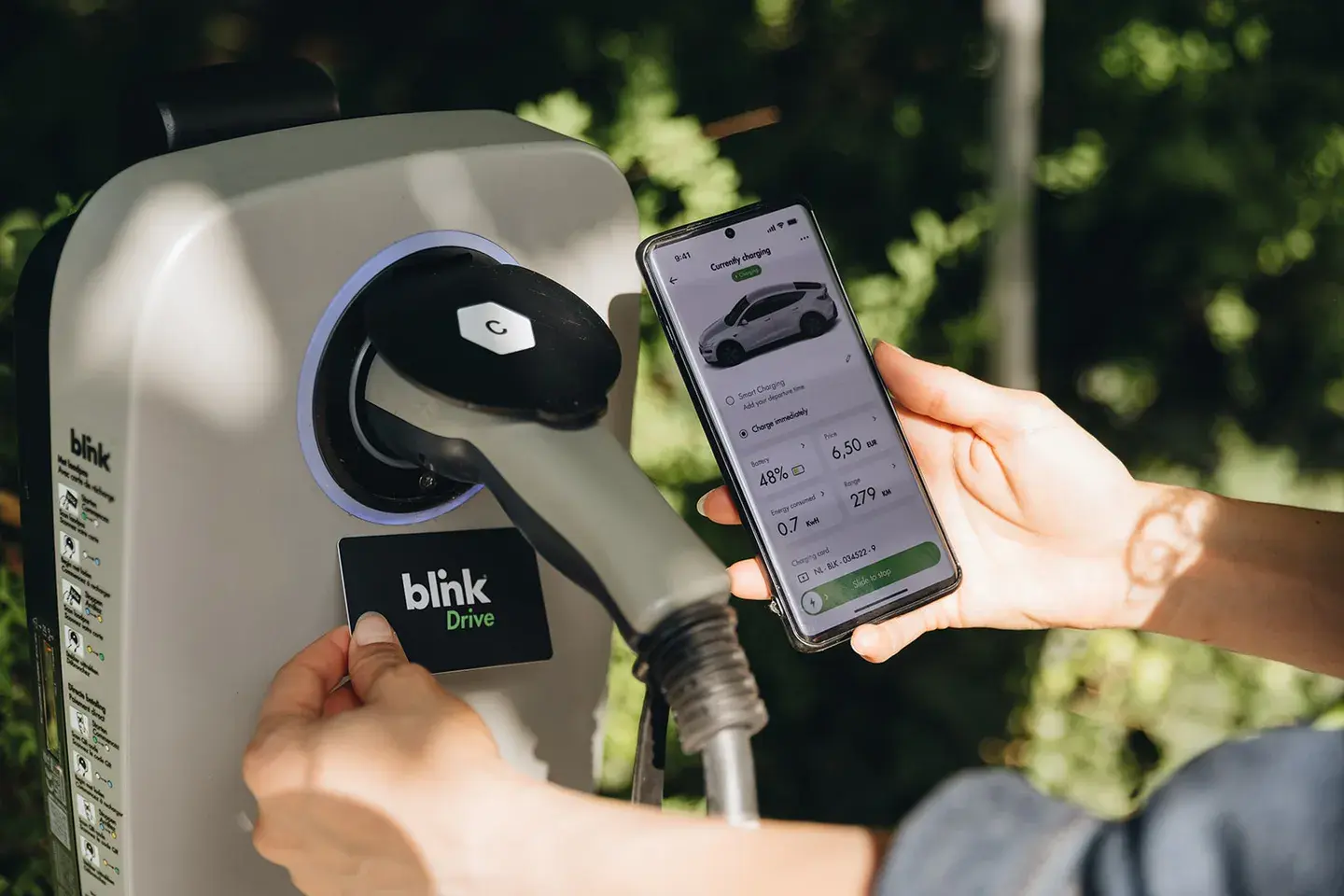
The infrastructure that makes access control practical, RFID authentication, app-based session management, and usage reporting, is covered in more detail in Blink's guide to workplace EV charging infrastructure.
Fair Use and Pricing Rules
An access eligibility framework tells employees who can use the charge points. A fair use policy tells them how. Without the latter, eligible employees can still monopolise charge points in ways that create resentment and undermine the benefit.
Session duration limits. A time cap on charging sessions, typically four hours during core working hours, ensures that charge points cycle through users across the day rather than being committed to a single vehicle from the moment it arrives. For many employees this is more than adequate; a fully depleted 40kWh battery at a standard 7kW AC charge point is restored to 80 percent in around four and a half hours, so a session limit of four hours meets the practical charging needs of most commuters without unnecessarily restricting access.
Electricity cost recovery. Whether to offer free charging or to recover the electricity cost from employees is a significant policy decision with implications for employment contracts, payroll, and employee relations. Free charging is the most straightforward arrangement and avoids the complexity of billing, but it carries a recurring electricity cost that increases as EV ownership grows. A cost-recovery model using a flat pence-per-kWh rate, administered through the charge point management system, keeps the employer's outlay neutral without creating a disproportionate burden on employees. Workplace EV charging is currently exempt from benefit in kind tax and National Insurance contributions, provided the facilities are made available to employees generally. HMRC's guidance on this exemption is worth reviewing to ensure the policy is structured to preserve that status; for example, reimbursements for charging costs incurred elsewhere do not qualify.
Overstay charges. A vehicle that remains connected after its session is complete occupies a charge point without using it, blocking access for colleagues. A clear overstay policy, including a push notification when charging finishes, a reasonable grace period, and a defined fee for overstay, addresses this predictably and without the need for human adjudication.
Health, Safety & Legal Compliance
Workplace EV charging infrastructure is subject to the same regulatory framework as any other fixed electrical installation, and a compliant policy needs to reflect that.
Electrical installation standards: All charge points and associated wiring must be installed by a qualified electrician in compliance with BS 7671:2018+A4:2026 (the IET Wiring Regulations, 18th Edition). Installations forming part of a building regulations submission are subject to Part P (electrical safety in dwellings) or the equivalent commercial provisions. Installation certificates should be retained.
Periodic inspection and testing: Fixed electrical installations, including charge point infrastructure, should be periodically inspected and tested under the employer's electrical safety programme. Test records should be maintained and accessible to insurers and to any regulatory authority.
Employer liability: Charge points installed on employer premises are covered by the employer's duty of care under health and safety legislation. The organisation's insurance arrangements should be reviewed to confirm that EV charging equipment is within scope for both property and liability cover.
UK GDPR and data handling: Charge point management systems that log session data, including times, durations, energy consumed, and user identity, are processing personal data under the UK GDPR. The organisation's data protection policy should address this data category, employees should be notified of what is collected and why, and retention periods should be set proportionately.
Compliance sign-off across facilities, HR, legal, and IT before the policy is published avoids gaps that create problems down the line.
Managing Behaviour and Demand
Even the most carefully designed policy requires active management as conditions change. The operational challenges that arise most frequently in workplace charging environments are largely predictable, and the policy should address them before they occur rather than in response to them.
Non-EV vehicle occupation of charging bays. Bay markings, clear signage, and where the physical environment allows it, enforcement provisions such as barriers or parking management, reduce the frequency of this issue. The policy should specify that occupying a charge point bay in a non-EV vehicle is a breach of car park rules with defined consequences.
Demand growth outpacing capacity. As EV ownership grows among staff, utilisation of available charge points will increase. The policy should include a review trigger, for example when average bay utilisation consistently exceeds 60 percent, which commits the organisation to assessing whether additional charge points are needed. Linking this review to the broader infrastructure planning guidance in Future-Proofing Workplace EV Charging Infrastructure ensures that capacity decisions are made with a long-term view rather than reactively.
Inter-employee disputes. Disagreements between employees over session priority, overstay, or perceived unfairness in access arrangements occur occasionally. A documented policy with clear escalation procedures gives HR a defined framework to operate within, avoiding the improvised and inconsistent decision-making that damages staff relationships and confidence in the benefit.
Policies That Work for Everyone
The management platform that sits behind workplace EV charge points is what makes a written policy operational. Blink's network tools include RFID-based access control, session scheduling and time-limiting, configurable pricing tiers, overstay notifications, and reporting dashboards that give HR and facilities managers the visibility they need to assess whether the policy is working and when it needs to be updated.
For organisations establishing a workplace charging policy for the first time, the combination of clear governance and capable management technology turns a potentially fraught resource allocation challenge into a benefit that employees value and the organisation can be confident is being managed fairly, compliantly, and at a cost it has control over.
The investment in getting the policy right from the start pays back quickly, in lower management overhead, higher employee satisfaction, and an infrastructure that is ready to grow as EV adoption among the workforce continues its upward trajectory.
To find out more about employee EV charging at work, visit Blink's workplace charging solutions for a complete service overview.