
Skip to Main Content

Funding

Find EV charging grants & incentivesExplore programs

Car Park EV Charging Infrastructure

Posted 20/05/2026

Ask anyone who has overseen a car park EV charging project that went wrong and they will tell you the same thing: the mistakes were made before a single cable was pulled. Undersized boards, inadequate duct runs, charger types mismatched to the user profile. By the time the problems surfaced, the remediation cost had doubled the original budget.

Getting the infrastructure right from the outset is not just an engineering preference. It is the difference between a system that scales gracefully over the next decade and one that requires expensive rework just as demand is accelerating. This guide covers the technical building blocks of effective car park EV charging infrastructure, from charger selection and power management through to layout design and long-term scalability planning. For an introduction to Blink's car park charging offer, visit our EV parking solutions.

Core Components of Car Park EV Charging Infrastructure

Effective EV charging in a car park environment depends on several interdependent layers, each of which must be correctly specified and properly integrated. A failure in any one layer creates problems that are expensive and disruptive to fix retrospectively.

The key components are:

  • Charge points: The front-end hardware installed at each bay. Selection criteria include output power (7kW, 22kW, 50kW+), connectivity (OCPP compliance for network management), physical format (wall-mounted, pedestal, twin-socket), and weatherproofing rating for exposed locations.

  • Distribution board and metering: The electrical hub that routes supply from the grid connection to individual charge points, with energy metering per unit or per circuit to support billing and consumption reporting.

  • Load management controller: The system intelligence layer that allocates available power across active charge points dynamically, preventing demand spikes that would breach the site's grid capacity limit.

  • Network management platform: The back-end software handling authentication, session billing, remote diagnostics, and usage reporting. This is the operational control layer, the system through which an operator sees what every charge point on site is doing at any given moment.

  • Cabling and civil infrastructure: The physical route from distribution board to charge points, including cable sizing, trunking, conduit, and duct runs. Often the most consequential element for future expansion: it is far cheaper to install excess duct capacity now than to add cable routes later.

Understanding how these components interact is essential before specifying anything. Charge point selection, board sizing, load management configuration, and duct layout are not independent decisions. They are a system, and they need to be designed as one.

AC vs DC Charging in Car Parks

Charger type selection is the decision that most directly determines both the user experience and the capital cost of the project. The choice between AC and DC is not a technical abstraction. It has real consequences for what drivers can do with your charge points and what you spend to install them.

When AC Charging Is Best

AC charging at 7kW or 22kW is appropriate for the vast majority of car parks, particularly those serving users with parking durations of 90 minutes or more: daily commuters, shoppers, long-stay visitors, and employees. At 7kW, a vehicle gains roughly 30 to 40 miles of range per hour, delivering a meaningful top-up or near-full charge during a typical working-day park.

AC infrastructure is lower in capital cost, simpler to install on standard electrical supply, and compatible with every EV on the road. For operators at commercial car parks or multi-storey facilities where dwell time is the defining characteristic of the user profile, AC charging delivers the right outcome at the right cost. For a deeper look at how this plays out specifically in commercial settings, see our guide to EV charging for commercial car parks.

When DC Charging Makes Sense

DC fast charging adds range at a fundamentally different rate to AC. At 50kW, a vehicle can gain 50 to 80 miles in 30 minutes; at 100kW and above, some vehicles can exceed 100 miles in the same period. This makes DC the right choice for car parks serving users with short or unpredictable dwell times: transport interchange facilities, service areas, retail destinations with rapid footfall turnover, or flagship locations where operator positioning demands a premium charging offer.

The cost profile is substantially different. DC units are more expensive to purchase, require higher grid capacity, and take up more physical footprint. Deploying DC across an entire site is rarely appropriate or economical outside specialist high-throughput environments. The practical model that works at most mixed-use sites is a hybrid: a small number of DC bays positioned at the car park entrance or in a clearly signed express zone, with AC units equipping the bulk of the bays. This meets the needs of time-sensitive drivers without the capital outlay of a full DC rollout. For public car park operators specifically, see our dedicated guide to EV charging for public car parks.
Power, Grid & Load Management

Most car parks were not designed with vehicle charging in mind, and the existing electrical supply reflects that. Lighting circuits, lifts, ventilation systems, and payment terminals have modest aggregate demand compared to even a modest EV charging deployment. Before a single charge point is specified, the site's available electrical capacity needs to be properly assessed.

That assessment should establish the current maximum demand, the headroom available for EV charging loads, and whether a new or upgraded connection from the Distribution Network Operator is required. DNO connection upgrades are frequently underestimated in project planning. Lead times of three to six months are common for standard upgrades, with complex applications in constrained network areas taking longer, and the cost can represent a significant share of the total project budget. Identifying this requirement early, before hardware is ordered or civil works are committed to, is one of the most valuable things a specialist infrastructure partner brings to a project.

Dynamic load management software is the operational solution to limited grid capacity. Rather than hard-allocating a fixed power ceiling to each charge point, which quickly exhausts available supply when multiple vehicles charge simultaneously, a load management system monitors real-time draw across the entire charge point estate and distributes available power proportionally. Vehicles that need charge receive it; those that are nearly full or idle have their allocation reduced. The site never exceeds its grid capacity limit, regardless of how many sessions are active.

Properly configured load management can support substantially more charge points on a given electrical supply than a fixed-allocation approach would allow, reducing or eliminating the need for a grid upgrade and improving the economics of the project materially.

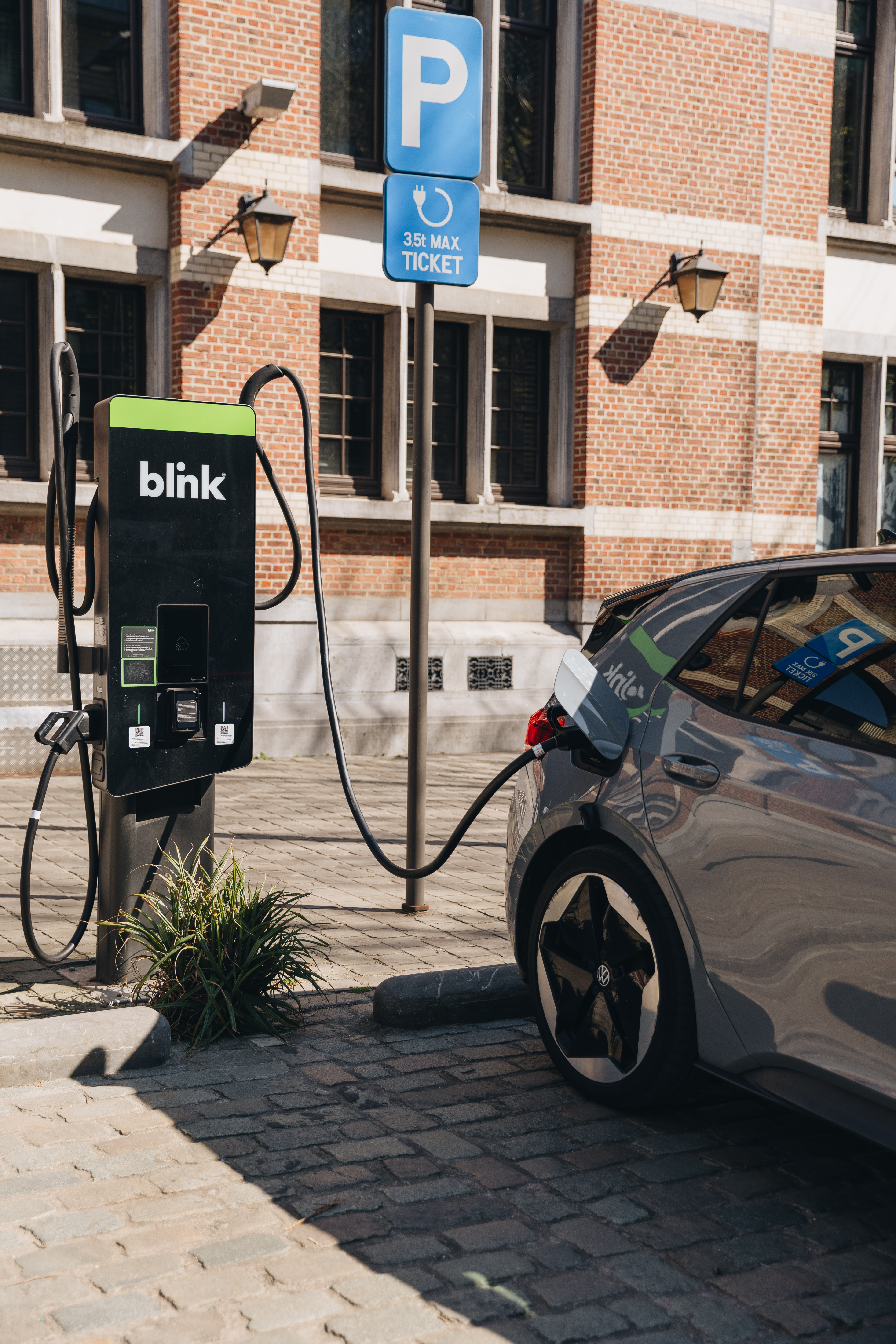
Electric car charging at a Blink station in a cobblestone parking area, near a brick building. A parking sign reads "35€ Max Ticket."

Physical Layout & Bay Planning

Layout decisions that seem minor at the design stage have a habit of becoming expensive problems once construction is complete. Charge point positioning affects installation cost, driver experience, accessibility compliance, and the ease of future expansion. Getting the layout right requires thinking about all four simultaneously.

Key layout considerations include:

  • Cable run length: The cost of cabling scales directly with cable run length. Positioning charge points close to the distribution board reduces both cable material cost and installation labour. Where the car park layout makes short runs impractical, surface-mounted trunking is generally less expensive than buried conduit.

  • Bay dimensions and charger reach: EV charging cables on standard AC units are typically 4 to 5 metres. The charge point must be positioned so the cable can reach the vehicle charging port comfortably regardless of parking angle or vehicle size. Narrow bays or awkward approach angles create genuine usability problems that reduce driver satisfaction and repeat usage.

  • Accessibility compliance: PAS 1899:2022 specifies minimum bay dimensions, cable reach requirements, and the proportion of accessible units for publicly accessible EV charge points. Designing to these standards from the outset, even for sites not immediately subject to the standard, avoids costly reconfiguration as regulatory requirements evolve.

  • Future duct planning: Installing additional conduit runs and duct capacity beyond the footprint of the current installation is the single highest-value future-proofing measure available. The marginal cost of additional duct during first-fix civil works is small. The cost of adding duct retrospectively, through finished floors, structural walls, or occupied multi-storey decks, is not.

Designing for Scalability & Future Growth

The UK's transition to electric vehicles is not a long-term trend. It is a near-term operational reality. New pure petrol and diesel car sales end in 2030 under the UK's reinstated ZEV transition timeline, with all new cars required to be fully zero-emission by 2035. The share of EVs on the road is already compounding upward every quarter. BEVs accounted for nearly one in four new UK car sales in 2025, and the pace will only accelerate. A car park operator who installs eight EV charge points today and makes no provision for expansion is making a decision they will almost certainly regret before the decade is out.

Scalability is addressed at three levels. First, electrical capacity: the distribution board and grid connection should be sized for the charge point density the site will eventually require, not just the number being installed today. If the site can support 24 EV charge points at maturity, the board should be sized accordingly even if only 10 are installed at first-fix.

Second, civil infrastructure: duct runs should extend to future charge point locations, leaving labelled and capped conduit ends ready to receive cable when additional units are commissioned. This is the most cost-efficient scalability measure available and adds negligible cost at the point of initial installation.

Third, platform capability: the charge point management system should handle additional units without requiring re-architecture. Explore the full commercial product range from Blink to see how hardware and software scale together across multi-site deployments.

Building the Infrastructure That EV Adoption Demands

A well-designed car park EV charging infrastructure is not just a utility installation. It is a long-lived commercial asset that needs to perform reliably for the operator, deliver a good experience for drivers, and have the capacity to grow as EV adoption makes increasing demands of it.

Blink works with car park operators across commercial and public sectors on projects that span initial feasibility and site survey through to DNO engagement, hardware specification, civil works, charge point installation, load management configuration, and ongoing network management. The approach is whole-project rather than hardware-only because the decisions that matter most are made before the first piece of equipment is ordered.

Whether the project is a first installation or a capacity review of an existing deployment, early specialist input delivers better outcomes and lower total cost. Discuss your project with us, visit Blink’s EV parking solutions or review our full commercial charging product range.

Share this post