Skip to Main Content

ESG

Blink is committed to sustainability.Learn More
Find a station


Request A Quote

How Cooperative Purchasing Makes EV Infrastructure Easier and Saves You Money

Posted 12/10/2025

Many procurement officers, sustainability directors, facilities managers, and organizational transportation leads in various state, local and educational agencies are making the switch to electric vehicles (EVs). Many fleets are switching to EVs as a commitment to demonstrating climate leadership through action in their communities, while others are doing it to save money and for various other reasons.. However, going electric isn’t as simple as just purchasing new vehicles. When you switch your organization’s fleet to electric, you are now responsible for the in-house fueling of those vehicles, which means you will require electric vehicle charging infrastructure, as well. 

And this is where much of the problem lies. EV fleets come with an entirely new playbook in the form of infrastructure that is often unfamiliar to procurement officers. Not only do they have to create requests for proposals (RFPs) about equipment they may not know much about, they also have to make judgement calls about which companies are reliable and will be around for the long haul in this new and rapidly developing industry. They also need to make sure they choose an EV charging partner that fits within their budget, and also make sure the electrification equipment they choose adheres to all compliance guidelines.

But, what if you could skip the RFP and still get competitive pricing on EV chargers, installation, and service?

You can. 

The answer is cooperative purchasing. 

What Is Cooperative Purchasing?

Most people who have purchasing power for a state, municipal, or educational agency probably already know what cooperative purchasing means, but we will quickly go over it here. 

Essentially, cooperative purchasing is when a vendor has a single contract or agreement with several purchasers. The advantage of cooperative purchase agreements is that the purchasing parties can use economies of scale to lower prices by combining their purchasing power and buying in bulk. 

And, thanks to “piggybacking,” new organizations dealing with a vendor can take advantage of already-established purchasing contracts by piggybacking on the terms that are already in place. 
Not only do purchasing organizations get better pricing, using already-established contracts can speed up the acquisition process by skipping the RFP phase and guaranteeing compliance because those contracts will have compliance built into them, as all the purchasing partners will need to comply with the same regulations. 

For example, let’s say there is a school district in Blink’s home state of Maryland that needs to purchase 10 Level 2 electric vehicle charging stations to power its fleet of electric school buses. If that school district were to go it alone, it would have to put out an RFP, wait for proposals to come in, and vet them one by one to ensure they are from reliable companies and that the equipment will be compliant with all the regulations the school district is obligated to follow. This would likely take months to coordinate and execute and the school district still might not end up with the best deal for the money it’s spending because the equipment will be priced for this single contract. Single project RFPs can easily lead to delayed projects, blown budgets, and disappointing outcomes.  

With cooperative purchasing, on the other hand, the school district could use an already established agreement on a service like AEPA or Sourcewell to get locked-in pricing on equipment that the school district knows will be reliable and compliant. Cooperative purchasing services only work with reliable vendors and many of the purchasers will have the same compliance needs as our example school district. 

So, the school district can find the Blink AEPA contract, for example, and get the EV charging infrastructure it needs, at pricing that has already been set at a lower, bulk rate. And, because it’s working with a cooperative purchasing service like AEPA, the school district knows that Blink is a reliable electrification partner and the infrastructure will comply with all regulations.


Why Cooperative Purchasing Matters for EV Infrastructure Projects

Many state, local, and educational public sector fleets are following suit and going electric. But, while EV infrastructure benefits are numerous – including savings on fuel and a better environmental footprint – getting started with the purchase and installation can be confusing, unnecessarily expensive, and time consuming for those who are not familiar with it and who purchase their infrastructure on individual contracts. 

Cooperative purchasing solves all these issues by making equipment procurement more streamlined, stretching budgets further with bulk pricing, speeding up implementation by allowing purchasers to piggyback on existing contracts, and guaranteeing compliance because most purchasers are going to need to meet the same guidelines. 

All of these points put together also allow for easier scalability for organizations that want to start small and grow as their demand grows. This is important because fleets generally will not electrify all at once. They will often electrify their fleet by waiting for their ICE vehicles to reach the end of their service lives and replace them with EVs, meaning they will require only a few EV charging stations to begin with and add more as their fleet continues to transition to electric. 

While benefits like lower prices and faster procurement are obvious for purchasing organizations, the additional benefit is that cooperative purchasing means taxpayer money that funds state, municipal, and educational agencies is being used as efficiently as possible.

Blink Charging and cooperative purchasing: a turnkey advantage

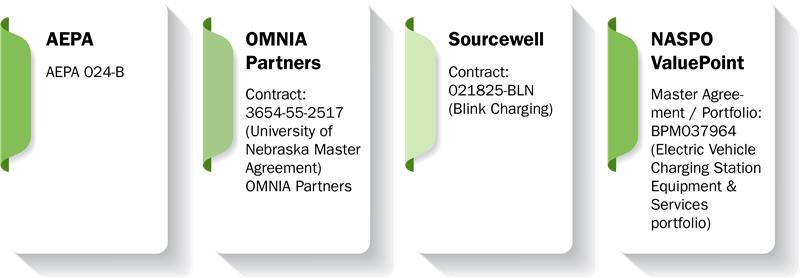
Blink’s EV charging stations are available under cooperative contracts with OMNIA, Sourcewell, NASPO, and AEPA

In addition to the electrification equipment itself, Blink also has complete turnkey services where we can install, maintain and service the infrastructure depending on which one of our flexible ownership models you choose. 

In addition to that, Blink charging stations are integrated into the Blink Network, which gives you full control over who can use them and how they can be used. 

Blink has already partnered with state and local governments and educational agencies as their electrification partner of choice due to our one-stop-shop ability for EV infrastructure purchase, installation, and maintenance.

For example, the City of Richmond, VA chose Blink to identify key areas throughout the city to deploy critical EV infrastructure. Additionally, the contract included related services like site assessment and preparation, installation, maintenance, repair, parts and supplies, warranties, and product training.

Similarly, the City of Porterville, CA chose Blink to install 19 Direct Current Fast Chargers (with 28 ports) and three Level 2 charging stations (with six ports) across three City-owned locations.

These are just two examples of municipal governments that have partnered with Blink to help electrify their locales. 

At the state government level, Blink has been named as a trusted vendor in Colorado, Maryland, New York, and Utah, meaning that state agencies in those states that require electrification can purchase from Blink. Blink Charging infrastructure can also be procured via many state-level EV charging grants, which you can find by using the Blink Commercial Incentives Finder.

And the Fontana Unified School District is just one educational agency that we have helped by supplying the infrastructure to electrify their fleet of school buses. 

The bottom line: simplify, save, and scale

With cooperative purchasing, state, local, and educational agencies that need to electrify their fleets can save time and money, enjoy easier compliance, and easily scale their electrification efforts as demand grows. Best of all, though, they can assure the tax-paying public who fund them that their tax dollars are being put to work in the most efficient way possible. 

Blink Charging has been helping government and educational agencies for many years. Our experience with site assessment, installation, maintenance and service, along with integration into the Blink Network, ensures a smooth one-stop-shop implementation of electric vehicle charging infrastructure.

As City of Richmond Energy Program Manager Dawn Oleksy said: “We are excited to have the solutions offered by Blink available to us as we create a thriving and sustainably built environment.”

Learn how your agency can deploy EV chargers through a Blink cooperative contract by contacting Blink Charging today and speaking to an electrification expert.

Some of our contracts include:

Do you drive electric? Download the Blink Charging app today to start charging with Blink.

Are you a business or government that wants to attract more EV drivers to your property or community? Contact Blink Charging today to speak with an EV charging expert.

Share this post